Sunday, May 13, 2007

The Bible Does NOT Interpret the Bible

The word "interpret" is a dirty word to some Christian fundamentalists, believing that the Bible should never be "interpreted." Instead, they say "the Bible interprets the Bible."

I say that's silly. We have to interpret the Bible in order to understand it. If this sacred text is the object of interpretation, it cannot be the interpretor.

I believe certain Christians prefer to avoid speaking of "interpreting the Bible" because, ironically, they misinterpret 2 Peter 1:20,21:

Above all, you must understand that no prophecy of Scripture came about by the prophet's own interpretation. For prophecy never had its origin in the will of man, but men spoke from God as they were carried along by the Holy Spirit (NIV).
(Note: When isolated from its context, this is admittedly more confusing in the King James Version, which reads: "Knowing this first, that no prophecy of the scripture is of any private interpretation.")

Peter is not saying, as some understand it, that the prophets in Scripture must not be interpreted; he's saying that the prophets didn't invent their own prophecies. They didn't write them based on how they interpreted events and situations of their time -- their prophecies were inspired directly by God.

But we still have to read and understand them -- that's what it means to "interpret"!

I Googled the phrase "bible interprets the bible," and, after skipping over the results from my former church tradition, I came across this dandy paragraph:
The text of Scripture must be interpreted by historical exegesis, taking an account of its literary forms and devices, letting Scripture interpret Scripture and not relying on the knowledge of man. The reason we should let the Scripture interpret itself is because the bible always tells the truth concerning everything it talks about, but man continually makes errors. If man interprets the bible then the interpretation is open to error, but if the bible interprets the bible, it will always be completely true. This is why the exegesis of passages is important, so that we know what the scripture is actually saying, contrary to what we think it is saying.
I appreciate what the writer intends to say; he just isn't saying it correctly. His first sentence contradicts itself. Read it again and try to make sense of it. How can a person insist on "not relying on the knowledge of man," and then proceed to use "historical exegesis," taking into account "literary forms and devices"?

The definition of exegesis is "critical explanation or interpretation of a text or portion of a text, esp. of the Bible." You can't escape "interpretation" by hiding behind the word "exegesis."

I am sure the writer -- and all those who claim not to "interpret" Scripture -- really means that we should not interpolate our own ideas into the Bible. In other words, we should read Scripture carefully, trying to avoid reading things into it that were not intended by the original author. That would be sloppy interpretation.

Our goal is correct interpretation. What we think Scripture is saying ought to match what it is actually saying.

Friday, May 11, 2007

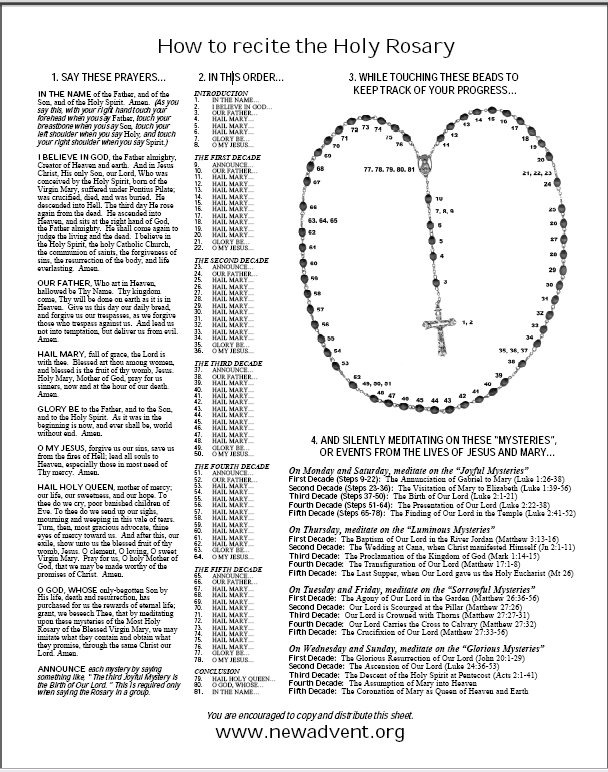
How to Recite the Rosary

Since the Rosary has been on my mind lately, I'm posting this link so you can download and view the PDF file shown above. This document shows how to pray the Rosary. It's excellent for people who are unfamiliar with the Rosary but want to know the bare-bones mechanics of how it is prayed.

This document is free to copy and distribute, and it was created by the industrious people at New Advent.

Tuesday, May 08, 2007

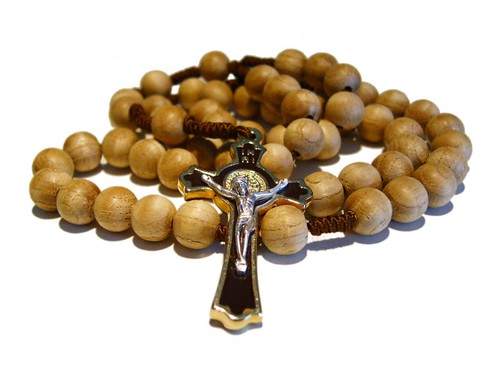
The Rosary: A Chain of Events

I briefly discussed the Rosary before ("Not All Repetitions Are 'Vain'"), but I want to clarify another aspect of this cherished Catholic prayer.

The first time I arrived early for Mass and witnessed a large group of parishioners reciting the prayers of the Rosary in unison, it struck me as almost haunting. Everyone was kneeling, thumbing their beads, and vocalizing ready-made prayers in a collective monotone voice that echoed throughout the church.

I wasn't used to that at all. It sounded almost pagan . . . whatever "pagan" sounds like.

But it all makes sense when you realize what's really happening. The Rosary prayers are not to be empty-headed recitals -- but quite the opposite! They are to be prayed with a full head of gospel meditations! The one who is praying should (ideally) have his mind focused on one of the "mysteries" (i.e., revealed truths) of Christianity.

Thursdays, for example -- like today -- are typically set aside to meditate on the "luminous mysteries," which are events from Jesus' earthly ministry. They include:
  1. The Baptism in the Jordan
  2. The Wedding at Cana
  3. The Proclamation of the Kingdom of God
  4. The Transfiguration
  5. The Institution of the Eucharist
In other words, during the first set of the "Hail Mary" prayers, which an outside spectator may mistake as dull and vain, the pray-er in reality is heart-deep in meditation on Jesus' baptism in the Jordan.

He may be pondering the importance of baptism, and how it is the normal entry gate to salvation through Jesus Christ; he may be imagining how John the Baptizer must have felt baptizing the Lord; he may be "listening" to John's words, "Behold, the Lamb of God, who takes away the sins of the world"; he could be placing himself at the scene, so to speak, to witness the Holy Spirit descend on Jesus as a dove, and listening to the words of the Father, whose words resounded from heaven: "This is my beloved Son, with whom I am well pleased"; he might be piecing together this baptism, which was done as our example, with the "born again" conversation Jesus had with Nicodemus -- found just two chapters later in the Gospel of John.

With just ten "Hail Marys" per mystery, time flies by quickly. I've caught myself going much more slowly when I notice I'm near the end. Oftentimes, the only way you know it's time to go to the next set (unless you want to continue that meditation) is when your fingers and thumb encounter the larger, "separator" bead. Then it's time for the next set -- that is, if you're ready to move along.

The reason the vocalized prayers sound either hurried or "dreary" to some is that the one who's praying is focused on the meditations and not on making colorful voice inflections. With practice, the combination of vocal prayer and meditative prayer has a way of harnessing your full attention.

Imagine the benefits of daily recitation of the Rosary. It's a prayerful rehearsal of the whole gospel story. Impure thoughts of any brand are replaced by the scenes of salvation history, revealed to us by Scripture and the Tradition of the Church.

What better way to purify your mind on a daily basis?

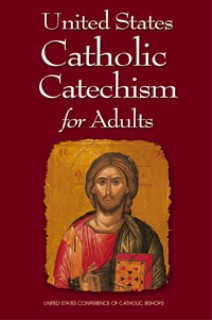
Save Over $10 on Offical U.S. Catechism

If you go to your bookstore to buy the United States Catholic Catechism for Adults, you'll pay $24.95 plus tax (plus gasoline if you have to drive far to get it).

I got mine for a little over $15. You can, too, if you order by May 15.

I don't mean to sound like a cheesy salesman, but I know I would appreciate the tip:

Go to Adoremus Books to get it. Now, here's the catch -- you get $10 off if you sign up for a Google Checkout account. This discount is only good for first-time users of Google's answer to "PayPal."

Paying with Google Checkout brings the price to $14.95. If your total order is at least $25, you get free shipping. So I bought a 50-cent plastic ruler to bump it over $25 (before discount). That means my final cost was $15.45 -- saving at least $10 compared to driving to the book store.

My plastic ruler arrived broken, but I didn't complain. I was more interested in reading about the Eternal Ruler.

Monday, May 07, 2007

Sit, Stand, and Kneel (Rosary Army)

This is an informative, somewhat humorous and entertaining video -- about five minutes long -- that explains why Catholics sit, stand, and kneel at Mass. Produced by our friends at Rosary Army, this is the first episode of the video podcast, That Catholic Show.