
Sunday, May 06, 2007

Spidey and His Web of Faith

(BEWARE: The following post may spoil the movie for you if you haven't seen it yet.)

Last night I watched Spider-Man 3. I give it all eight thumbs up -- not just for its amazing action, but for its Christian themes. I did some World Wide Web-crawling of my own, and apparently I'm not the only one who saw Christian elements within. In this movie, it's just plain obvious.

Spider-Man 2
When I saw Spider-Man 2, I detected what I thought to be Christian imagery. In this movie, the miracle-working Web-Head fell out of favor with the populace, the hearts of which were hardened against him.

But Spidey loved them while they were yet sinful citizens, and he was willing to sacrifice his life to save them from a train wreck. The method he employed to do this was with arms outstretched and his hands bound, enduring great pain and suffering by his own free will. Notice, too, the hole in the side of his costume.

True, this is all cruci-fiction, but there is nothing fictitious about what it portrays: the power of love. The passengers' ride on the Gospel Train was a turning point in the movie.

The Web-Slinger acted as a selfless savior. As shown in the picture, He was fully Spider-Man and fully Peter Parker, one person with two natures. He collapsed as if dead, and then "came back to life," as it were, when he regained consciousness before a host of witnesses in the train, who came back around to believe in him.

Spider-Man 3
In the third movie, which I just viewed, I saw Peter Parker acting out the Christian life.

Because of his successful crime-fighting career and all the accolades he received, Parker swelled with pride. This opened the door to sin's overpowering darkness, represented by the black, creepy-crawly extraterrestrial symbiote that enveloped him and increased his capacity for doing evil.

His conscience, however, was a law unto itself. Despite the gravity of his sins, something inside tugged at him. Finally, when he hit his low point (when he hit his beloved Mary Jane), he felt a strong conviction, realizing what kind of monster he had become.

When he stepped outside, he gazed upon the cross. This cross was at the top of a nearby church -- a Catholic church, I might add. He webbed his way up the church and sat prayerfully on the side of the church tower underneath the cross.


He then entered the structure and attempted to tear off the black "sin-biote" that had overtaken him. He was successful only during the sounding of church bells, which symbolize a call to worship.

It seemed odd -- but fascinating to me -- that, immediately following the church scene, Peter Parker basked in and found great comfort in taking a shower. It looked like a deliberate reference to the cleansing waters of baptism, after which his repentance continued to deepen.

Some time after Peter's sacramental shower, the real killer of Uncle Ben offered a confession of his murder to Peter. After the killer expressed remorse, both were in tears, and, as if serving a priestly function, Peter confidently spoke the words, "I forgive you." The killer went away knowing he was truly forgiven.

We also saw two people who died in the end: one who repented and one who did not:
  1. Harry, who had been Spidey's enemy, changed his heart and became Peter's friend again. It turned out as was foreshadowed earlier in the film: he gave his life for Peter.
  2. The other person, Brock (or "Venom"), loved the sin of the symbiote that attached itself to him after Peter had ridden himself of it. Brock had full opportunity to be freed from the symbiote, but as it was about to meet its end, Brock ran toward it and thereby shared in its fate of incineration -- a type of hell.
Even the shadiest of moviegoers find themselves at least inwardly rooting for Peter Parker to triumph over evil in all its forms, whether they be outside forces or internal temptations.

For no matter who we are, we all admire goodness and the integrity of truth. What not everyone realizes is that Jesus is the embodiment of truth, and that as Catholics we are blessed with the full revelation of that Truth.

As we reflect on this, we are provided with plenty of reasons to Marvel.

Thursday, May 03, 2007

"Routine-istic"


I think she blended "routine" with "ritualistic."

My Filipino friend was explaining why she became Baptist after moving to America a few years ago as a lifelong Catholic, citing routine Catholic rituals that didn't hold her interest. Her parish went through the same old things week after week.

Her new Baptist church, on the other hand, studies the Word of God and offers a warmer, friendlier environment, she says in so many words.

For me, at least, it's hard to reason with someone wooed by the warmth of a good Southern Baptist church without sounding argumentative or academic. I understand that not everyone who betrays her Catholic Faith is a victim of the warm fuzzies, but for those who are, I'm at a loss for words. While there's little I can say, of course there's much I can pray.

Still, I consider what my friend said, and I end up explaining it to myself in a way I can understand. (It's all about "cultivating the Catholic conscience.")

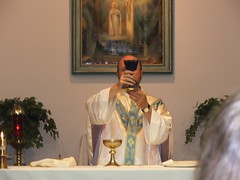
First, the Catholic Church is the premiere "Bible Church." It's the Church that preserved the Bible, canonized the books of the Bible, and exists as the Church of the Bible. We are engaged visually by the biblical scenes portrayed in works of art. We are engaged auricularly as we hear the numerous readings that systematically work their way through the Word of God, the Bible. And, most importantly, we are engaged spiritually by literally communing with the Word of God through the Real Presence of the Eucharist.

If you're looking for a solid "Bible study" -- examining the depths of Holy Writ -- then there are many such Catholic Bible studies. It's just not the goal of the divine liturgy. Mass is a class, but for the spirit and not necessarily (although sometimes) for the intellect. That's what Wednesday- and Sunday-night Bible studies are for. You cannot read the works of Catholic writer and teacher Scott Hahn, for example, and claim that Catholics have little to offer those who hunger for in-depth Bible study.

If you're looking for social networking, you can go to any number of your parish's activities -- but Mass is not the live Catholic version of Yahoo!'s "Chat Central."

You can find friends and studies easily enough as a Catholic, but most importantly you get:

  • All the sacraments, notably the Eucharist and Reconciliation
  • Bishops and priests who are given authority to say Mass
  • The pope, successor to St. Peter, the "rock" upon whom Christ built His Church, who shepherds the "Church militant" (i.e., the Church on earth)
  • Authentic teaching handed down by the apostles, preserved and codified by the Church's Magesterium throughout its history

Yes, it's easy to get hooked on a religious feeling, but why not seek to be reeled in by the Truth who will set you free?

I'll pray that my friend returns to full communion with the Church, which, in obedience to Jesus' ancient instruction, goes through the "same old things week after week": celebrates Mass (1 Corinthians 11:23-26).

Monday, April 30, 2007

Suppertime Sin?

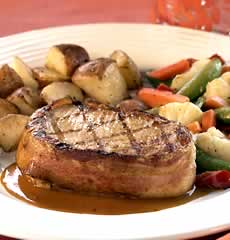
Have you ever sat at the dinner table in front of steamed veggies, a lean and seasoned pork chop, mashed potatoes, and a cold glass of milk, wondering whether consuming this meal is sinful -- opposed to Christian teaching?

Some Christians, for religious reasons, object to that lean and seasoned pork chop being on the dinner table. Citing Leviticus 11 and Deuteronomy 14, they insist that it is "unclean meat," which God forbade the ancient Israelites to eat. That much is true -- God DID command them to avoid certain meats. But do these laws pertain to Christians -- now?

I thought they did. I was raised in a church that taught it was a sin for a Christian to eat pork, lobster, shrimp, catfish, and a host of other foods. I believed that to do so was to disobey God's instructions, and that it was the cause for numerous health problems in society. Listing various "clean" and "unclean" meats, the Bible presented us with a divine diet. I believed it was the Maker's menu for the health of humankind.

When I was older, however, I reached another conclusion. Based on a more fair and critical examination of Scripture, I came to understand the historic Christian understanding of these and certain other laws -- that they were given to a particular audience and were not intended to apply universally to all societies throughout the ages.

Very simply, in the interest of time (and your attention span), here is my belief regarding clean and unclean meats:

While it is possible that unrecorded health issues of the time were included, God gave Israel their dietary laws as a sign or reminder that He separated them from among the other sinful nations to be His people. Since God is no longer dealing primarily with the nation of Israel, but calling all nations to repent and to be His people, the laws that distinguished Israel from her neighbors have served their purpose. They do not directly pertain to our circumstances, and therefore serve no practical purpose now.

Wherever these clean and unclean meats are discussed in Scripture, the reason for them is either implied or explicitly stated. It is most clearly stated in the following passage:

Leviticus 20:24-26:
I am the LORD your God, who has set you apart from the nations. You must therefore make a distinction between clean and unclean animals and between unclean and clean birds. Do not defile yourselves by any animal or bird or anything that moves along the ground—those which I have set apart as unclean for you. You are to be holy to me because I, the LORD, am holy, and I have set you apart from the nations to be my own.
As Christians, we are free to choose to avoid certain meats (or even all meats) based on conscience and nutritional views. It is a mistake, however, to claim biblical authority for demanding that catfish dinners be banished from the Christian's menu.

A Hare Out of Place


Rabbits are known for their rate of multiplying, but this little guy almost divided himself into 1000 when he barely escaped the whirring blades of my Snapper riding mower this weekend.

He had been hiding in some tall grass, and I saw the little fur ball leap from out of the mowing deck, it seemed. I thought I had "processed" a squirrel, but the bunny ears gave it away. I hopped off the mower to more carefully examine him. Seeing that he was fully intact, I took him home to show the wife, and, because of her natural ability with animals, he seemed at ease and was willing to pose for some photographs.

After the photo shoot, I released him near the place where I almost prematurely ended his math career.

I am reminded of how some people think I over analyze things because I'm always asking questions and trying to solve every "what if." But I'm hoping this puts it to rest: Although sometimes I come close, I'm not a hare-splitter.

Saturday, April 28, 2007

Passover and Easter

The Bible does not stand alone as a victim of sloppy interpretation. Most any text -- some more easily than others -- can be misread and misunderstood.

I recently received a comment on one of my older posts. The commenter undoubtedly believes that Easter is a pagan holiday to be avoided, and that Christians instead should observe the "Lord's Supper" only on the night of the Jewish Passover.

Because I find it valuable to examine the beliefs of the Early Church, the commenter posted a quotation from ancient historian Eusebius (pictured above), who cited a letter from Polycrates to the Roman bishop Victor. Polycrates, based on a tradition he says comes from the apostle John, insisted on observing the date of the Jewish Passover, while Victor insisted on maintaining the Sunday observance for Easter. Earlier that century, Polycarp had the same argument with Anicetus.

The anonymous commenter concludes, "So now, who left the teachings of the first generations of Christians?"

I am sure the commenter overlooks certain points when reading this account from Eusebius' History of the Church:

  1. It's evident that there was a certain kind of authority or primacy associated with the bishop of Rome -- both Victor and Anicetus. Why did Polycrates and Polycarp insist on talking to the Roman bishop unless he had some sort of widely recognized authority in church matters? It also appears the Roman bishop had the authority to excommunicate whole parishes and regions from the faithful. (Note: This is long before Constantine and the Council of Nicea of A.D. 325.)
  2. The whole controversy was over specific dates, not specific celebrations. The truth is that they debated when to celebrate a special annual observance of the the death, burial, and resurrection of Jesus. Both sides of the controversy were speaking of the same event, but argued over when it was to be observed. It was not "Should we keep 'God's Passover' or 'pagan Easter'?" There is no evidence that the pope was trying to force a new celebration upon Christians. Thus there was no outcry against colored eggs, Cadbury bunnies, or pagan accoutrements (secular, modern "Easter" symbols didn't arrive till much later).
  3. Polycrates and the others Asiatics on his side also observed a form of Lent. The length of "the fast" leading up to Easter (or Passover, whichever you wish to call it) also varied according to different traditions. But, unlike the anonymous commenter, they still observed this already ancient tradition.
  4. Despite their differences, after their visit, "Anicetus conceded the administration of the eucharist in the church to Polycarp, manifestly as a mark of respect." If Polycarp thought Anicetus was falling headlong into paganism, why did he agree to administer the Eucharist? By the way, because of their strong views, surely this particular Eucharistic celebration was held neither on the Jewish Passover date nor on Easter Sunday. It would have been an ordinary weekly Sunday, which was a customary practice for both of them.
There are other things I would like to point out, but not knowing for sure who the anonymous commenter is, I don't know which points to address.

To read about this in fuller context, read all of chapter 24 in Eusebius' work here.