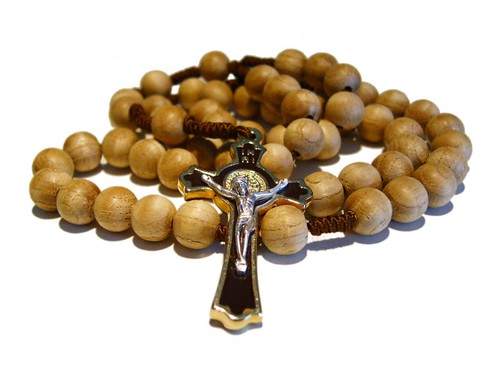
Showing posts with label rosary. Show all posts

Monday, February 09, 2015

Sharpen Your Rosaries With Scripture


Praying the Rosary, as magnificent and sweet as it is, can be challenging to the new convert and seasoned Catholic alike. Common to both is one big difficulty: a lack of focus.

Normally, as we make our ring around the Rosary, we should be meditating on the individual scenes of the joyful, sorrowful, luminous, or glorious mysteries. We should rehearse them in our minds and ponder them in our hearts, blending them into our own spirits, so that “we may imitate what they contain and obtain what they promise.”

I was an adult convert to the Church, so when I first began praying the Rosary, it took a little while to memorize the vocal prayers and recite them all properly. I was so intent on “doing it right”—saying the right words at the right time while navigating the beads—it felt that concentrating on the mysteries at the same time was nearly impossible.

But it was possible. After sufficient practice, I could go outdoors for a 30-minute nighttime stroll and think deeply on the mysteries while reciting the vocal prayers. Those were rich experiences: staring into the starry sky in the cool of the evening; lifting my heart to the Lord; finding a good pace with a peaceful rhythm in my breath, my fingers, and my thoughts.

Fast-forward a few years. These days, I can still struggle with focusing on the mysteries in prayer, but for different reasons. The vocal prayers are so ingrained in my muscle memory that the words just pour past my lips, and my fingers slide expertly over the beads, but my mind wanders from the mysteries. During the Hail Marys, my mind can go from updating my task list to planning my workout routine to thinking, “I really like blueberry pancakes!” Depending on the day, it can be a real fight to focus.

Nevertheless, I know I’m not alone when it comes to distraction. Don’t tell me you don’t occasionally have the same struggles. While some saints used to enter into mystical ecstasies while praying the Rosary, Saint Therese of Lisieux admitted in her autobiographical Story of a Soul, “[B]ut when alone (I am ashamed to admit it) the recitation of the Rosary is more difficult for me than the wearing of an instrument of penance. I feel I have said this so poorly! I force myself in vain to meditate on the mysteries of the Rosary; I don’t succeed in fixing my mind on them.” Later she realized her efforts to focus were pleasing to our Mother.

In my own efforts to focus, one very helpful aid I’ve come across is the Scriptural Rosary. The Rosary is plenty “scriptural” on its own, but a “Scriptural Rosary” is one in which you read a verse of Scripture (relating to the present mystery) before each of the ten Hail Marys. The effect is that, as your mind begins to stray, each Bible verse that’s read before a Hail Mary gently draws you back to the mystery, sharpening your focus and coloring the mystery with God-breathed Scripture. It becomes the food to nourish your meditations.

My wife and I often pray this way together at home and in the car, but it’s also ideal for families with children, who are not always known for their laser-beam focus. Kids can take turns reading the Bible verses while the others say the vocal prayers.

Give it a try. You can buy Scriptural Rosary booklets from Catholic bookstores, or download one for free as a PDF or MP3. Follow along and see if it doesn’t help your meditations. You owe it to yourself and your family to once again take up this powerfully biblical prayer—but this time with your mind fixed and focused on each mystery of the Rosary, sharpened one verse at a time.

Thursday, January 15, 2015

Is the Rosary a "Vain Repetition"?


“God is not interested in chants, endlessly repeated phrases, or the superstitious fingering of beads,” writes Fred Coulter, president of the Christian Biblical Church of God, in his book Lord, What Should I Do? Having already mentioned the Rosary, he continues, “Such methods are mechanical and have nothing to do with true biblical prayer. In fact, ritual prayers are evidence that we are just too busy to really pray from our hearts.


“The truth is that God does not want us to pray in any of these ways.” (p. 84).


To support his assertions, Coulter then quotes Jesus who says, “And when you pray, do not use vain repetitions, as the heathen do; for they think that by multiplying their words they shall be heard. Now then, do not be like them; for your Father knows what things you have need of before you ask Him” (Matthew 6:5–8).

Coulter continues by recounting the prophets of Baal (1 Kings 18), who “called on the name of Baal from morning even until noon, saying, ‘O Baal, hear us.’ But there was no voice, nor any who answered” (verse 26).

“This account...,” says Coulter, shows that “we need not pray like the heathen” (p. 86).

Is it reasonable to liken Christian prayers, such as a 15-minute Rosary, to the prayers of the prophets of Baal? Should Catholics worry that it is wrong to pray the Rosary—or any other prayer that is repeated or involves repetition?

Absolutely not—not if you’re a Bible-believing Catholic. Coulter understands neither the Rosary nor Scripture.

First, let’s start by agreeing that everything Jesus says is true. There is never, ever a reason to argue with Him. He is Truth itself. But then let’s see whether Coulter is in fact “believing His Bible” or imposing a popular Protestant spin on the words of our Lord.

Back to what Jesus actually said. Does He condemn the prayer of repetition? By no means. Rather, He condemns “vain repetition.”

Consider Jesus’ own example. He prayed in the garden that “this cup pass from me” (Matthew 26:39). He prayed it a second time. Then He “prayed a third time, saying the same words” (verse 44). Not just the same intention, but the “same words.”

The Lord also accepts worship from heavenly creatures—whom Coulter agrees are sinless—as they “rest not day and night, saying, Holy, holy, holy, Lord God Almighty, which was, and is, and is to come” (Revelation 4:8). Reciting the Rosary is definitely less repetitive than the prayer of angels.

Coulter says the “keys for truly sincere prayer that God will hear and answer are contained in the Bible, not in the precepts, superstitions, traditions or inventions of men” (p. 84). And, though he makes disparaging reference to “pre-written prayers,” he also says to “[u]tilize the book of Psalms in your prayers, as many of them are actually prayers. Read them aloud to God, adding your own thoughts or comments” (p. 92). Good. Catholics do that every day. I wonder: Does Coulter ever pray Psalm 136?

Read it aloud to hear its repetitiveness. In it, the phrase “for his mercy endureth for ever” is repeated 26 times in each of its 26 short verses!

The truth is that, in itself, nothing is wrong with repetition. It can serve to emphasize a prayerful thought, or to express that which is beyond the grasp to find other adequate forms of expression.

The Catholic Church, however, always faithful to our Lord’s teaching, does warn against “vain repetition,” even with regard to the Rosary. Listen to Pope John Paul II in his 2002 encyclical on the Rosary as he quotes Pope Paul VI:

Without contemplation, the Rosary is a body without a soul, and its recitation runs the risk of becoming a mechanical repetition of formulas, in violation of the admonition of Christ: ‘In praying do not heap up empty phrases as the Gentiles do; for they think they will be heard for their many words’ (Mt 6:7). By its nature the recitation of the Rosary calls for a quiet rhythm and a lingering pace, helping the individual to meditate on the mysteries of the Lord’s life as seen through the eyes of her who was closest to the Lord. In this way the unfathomable riches of these mysteries are disclosed.
Properly prayed, the Rosary encourages the pray-er to meditate on the various scenes and truths of the gospel, while simultaneously voicing the prayer Jesus taught us (the "Our Father," or "Lord's Prayer"—Matthew 6:9–15) and the words of Elizabeth and the angel Gabriel to Mary, the mother of Jesus (included in the "Hail Mary"—Luke 1:28,42). Just as Mary encountered the great mysteries of the gospel and "kept all these things, pondering them in her heart" (Luke 2:19; cf. 1:29; 2:51), so do we contemplate the mysteries of Christ alongside her.

Rather than a prayer that shows we "are just too busy to really pray from our hearts," it is a prayer designed to pray from our hearts. It's a meditation on the gospel.


So never let so-called “Bible Christians” cast doubt on Catholic teachings or approved devotions, because, after 2000 years, the Catholic Church has never ceased being the preeminent “Bible Church”: the Church that Jesus built.


(To learn how to pray the Rosary, download this one-page PDF from Rosary Army).

Friday, May 11, 2007

How to Recite the Rosary

Since the Rosary has been on my mind lately, I'm posting this link so you can download and view the PDF file shown above. This document shows how to pray the Rosary. It's excellent for people who are unfamiliar with the Rosary but want to know the bare-bones mechanics of how it is prayed.

This document is free to copy and distribute, and it was created by the industrious people at New Advent.

Tuesday, May 08, 2007

The Rosary: A Chain of Events

I briefly discussed the Rosary before ("Not All Repetitions Are 'Vain'"), but I want to clarify another aspect of this cherished Catholic prayer.

The first time I arrived early for Mass and witnessed a large group of parishioners reciting the prayers of the Rosary in unison, it struck me as almost haunting. Everyone was kneeling, thumbing their beads, and vocalizing ready-made prayers in a collective monotone voice that echoed throughout the church.

I wasn't used to that at all. It sounded almost pagan . . . whatever "pagan" sounds like.

But it all makes sense when you realize what's really happening. The Rosary prayers are not to be empty-headed recitals -- but quite the opposite! They are to be prayed with a full head of gospel meditations! The one who is praying should (ideally) have his mind focused on one of the "mysteries" (i.e., revealed truths) of Christianity.

Thursdays, for example -- like today -- are typically set aside to meditate on the "luminous mysteries," which are events from Jesus' earthly ministry. They include:
  1. The Baptism in the Jordan
  2. The Wedding at Cana
  3. The Proclamation of the Kingdom of God
  4. The Transfiguration
  5. The Institution of the Eucharist
In other words, during the first set of the "Hail Mary" prayers, which an outside spectator may mistake as dull and vain, the pray-er in reality is heart-deep in meditation on Jesus' baptism in the Jordan.

He may be pondering the importance of baptism, and how it is the normal entry gate to salvation through Jesus Christ; he may be imagining how John the Baptizer must have felt baptizing the Lord; he may be "listening" to John's words, "Behold, the Lamb of God, who takes away the sins of the world"; he could be placing himself at the scene, so to speak, to witness the Holy Spirit descend on Jesus as a dove, and listening to the words of the Father, whose words resounded from heaven: "This is my beloved Son, with whom I am well pleased"; he might be piecing together this baptism, which was done as our example, with the "born again" conversation Jesus had with Nicodemus -- found just two chapters later in the Gospel of John.

With just ten "Hail Marys" per mystery, time flies by quickly. I've caught myself going much more slowly when I notice I'm near the end. Oftentimes, the only way you know it's time to go to the next set (unless you want to continue that meditation) is when your fingers and thumb encounter the larger, "separator" bead. Then it's time for the next set -- that is, if you're ready to move along.

The reason the vocalized prayers sound either hurried or "dreary" to some is that the one who's praying is focused on the meditations and not on making colorful voice inflections. With practice, the combination of vocal prayer and meditative prayer has a way of harnessing your full attention.

Imagine the benefits of daily recitation of the Rosary. It's a prayerful rehearsal of the whole gospel story. Impure thoughts of any brand are replaced by the scenes of salvation history, revealed to us by Scripture and the Tradition of the Church.

What better way to purify your mind on a daily basis?