Showing posts with label armstrongism. Show all posts

Sunday, April 27, 2008

An Early Witness Puts 'Soul Sleep' to Rest

Just as Jehovah's Witnesses believe, I grew up believing that when a person dies, he or she remains in an unconscious state until the resurrection of the dead. I believed our souls could not survive the body. I believed this to be the biblical understanding, and that Christians believed this until pagan philosophy infiltrated the Church, certainly by A.D. 325 at the Nicene Council.

The orthodox Christian understanding (which I now hold) is that the soul indeed survives the body and awaits the resurrection, in which our souls are reunited with our resurrected, glorified bodies.

This morning, I was re-reading St. Clement's epistle to the Romans, and I came across a passage that struck a chord with me several years ago. Clement, who lived from A.D. 30–100, is likely the associate of the apostle Paul (see Philippians 4:3). He was the fourth bishop of Rome, following Peter, Linus, and Cletus.

His letter is quite early, dated at A.D. 97 at the latest—way before the "evil" influences of the emperor Constantine. The letter possibly could have been written while the apostle John was alive. Here is a passage I want to share with you:
But not to dwell upon ancient examples, let us come to the most recent spiritual heroes. Let us take the noble examples furnished in our own generation. Through envy and jealousy, the greatest and most righteous pillars [of the Church] have been persecuted and put to death. Let us set before our eyes the illustrious apostles. Peter, through unrighteous envy, endured not one or two, but numerous labours and when he had at length suffered martyrdom, departed to the place of glory due to him. Owing to envy, Paul also obtained the reward of patient endurance, after being seven times thrown into captivity, compelled to flee, and stoned. After preaching both in the east and west, he gained the illustrious reputation due to his faith, having taught righteousness to the whole world, and come to the extreme limit of the west, and suffered martyrdom under the prefects. Thus was he removed from the world, and went into the holy place, having proved himself a striking example of patience.
Clement describes the apostles as being in his "own generation," and upon their deaths, Peter and Paul (1) "departed to the place of glory" and (2) "went into the holy place." These would be strange descriptions if he believed in soul sleep. Neither did he act like he was introducing a new doctrine. He wasn't even attempting to explain the state of the soul at death. He merely wrote of martyrdom and spiritual heroes.

No longer must I contrive excuses for St. Paul, for example, when he speaks of being "absent from the body" and "at home with the Lord" (2 Corinthians 5:8). The natural meaning of his words are perfectly reasonable when I consider the beliefs of the early church—even those who personally knew the apostle. If this is the same Clement that is mentioned in Scripture, Paul called him a fellow laborer whose name was written in the book of life.

One thing that my Jehovah's Witness friends—and I myself, years ago—misunderstood is that Catholics do not believe that our reward is merely "when you die, you go to heaven." Instead, Catholics teach that our ultimate reward will involve the bodily resurrection, when our souls are reunited with our bodies.

The dispute boils down to whether the soul exists consciously during the interim. While that is the dispute, it was not a dispute during the time of the apostles and in the first generations of the Church. It was taken for granted.

Saturday, December 22, 2007

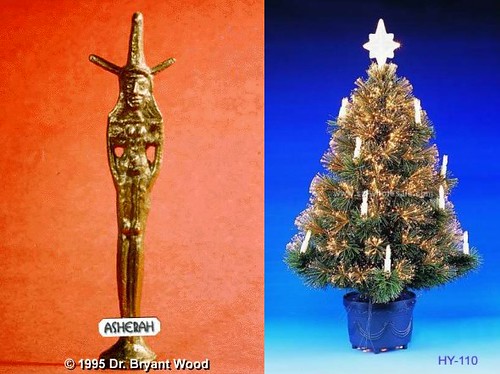
Unrelated: Jeremiah 10 and the Christmas Tree


Having grown up believing that Christmas is pagan and not to be observed by Christians, one classic scriptural misinterpretation I had was believing Jeremiah 10 condemned Christmas trees.

Read the passage for yourself here.

When I became of age and seriously began to "prove" my childhood faith to myself, I "proved" that God despised the practice of cutting down a tree from the forest, putting it on a stand, and decking it with gold and silver. Jeremiah described this so clearly, so explicitly -- how better could he have spelled out the plain truth about Christmas trees?

I later realized that my understanding of this passage was chiseled and fashioned by what my church had already taught me. I was already "suspicious" of Christmas, so I was quick to cling to conclusions when I saw such words (especially in the King James Version) as "tree," "axe," "deck," "gold," "silver," and "workman" (which I mistakenly understood to be synonymous with "lumberjack"). What else could this be except the modern Christmas tree? I thought. How could everyone be so blind?

Well, it took me a few more years myself to begin to see.

The chapter is properly understood when seen in its context of idolatry.

In this chapter, the Lord references "gods," "idols," and "images" (verses 11,14); in the KJV they are "gods," "graven image," and "molten image." Since when is there a commandment against using a tree as decoration? There is none. Why should God be angry with that? But He is sorely opposed to idolatry.

We see, therefore, that God opposes the practice of fashioning an image or statue (of any material) that is to be used as an idol -- an object of worship. Anything that takes the place of the true God -- whether a wooden idol, another person, or your own pride -- falls under the category of "idolatry," but in this context, God is specifically addressing the use of literal idols.

I have never known anyone to worship a Christmas tree. Now that I observe Christmas and have a decorative tree, I know with certainty that I do not worship it. It is not worshiped by those who view Christmas in the spiritual sense in which it's intended, and neither is it worshiped by those who see Christmas as a mere secular holiday as an excuse to party and accumulate material goods.

If a thing is not worshiped, and if it's not made by pagans to be an object of worship, it's not an idol. Is this not sensible?

Moreover, in verse 5 of Jeremiah 10, God mocks these idols by saying they are "upright as the palm tree, but speak not: they must needs be borne [i.e., carried], because they cannot go." In whose imagination might a Christmas tree appear to walk and talk? My artificial Christmas tree does not resemble anything that walks and talks; it resembles a blue spruce. It doesn't have a face, head, torso, arms, or legs. It's a bushy tree!

Was the tree of life in the Garden of Eden an idol? It had fruit that, if eaten, would provide eternal life. Who would label that tree an idol, or even a symbol of idolatry? No one. And no one assigns Christmas trees with the divine attributes of the tree of life of Genesis, so how can one conclude they are idols?

No matter how much someone wants to make it a sinister object of false worship, the Christmas tree is merely a decoration. If indoor decorative trees are an abomination, then let's ban the popular plastic ficus trees from Wal-Mart.

I don't question the sincerity of those Christians that are anti-tree and anti-Christmas, for I was one of them, and I know I was sincere. But I do know that my rejection of all things Christmas gave me a deficient understanding of the Incarnation, which is crucial and at the heart of Christianity. This all-important emphasis, I fear, is what anti-Christmas Christians are missing out on.

Instead, they're too busy cramming modern-day Christmas trees into the pages of the Old Testament.

Saturday, December 01, 2007

Christmas Really Does Honor Christ!


As Advent season arrives again, so does the annual explosion of anti-Christmas rhetoric. As if we don't get enough of it from atheists, some of it is published by various Christian sects who sincerely intend to restore the true Faith -- the Faith that was "once delivered to the saints," without extra, man-made garbage to pollute the clear water of the Word. Unfortunately, their pure intentions can lead to absurd conclusions, such as: Christmas is pagan.

One article that caught my attention this year is entitled "Does Christmas Really Honor Christ?" I truly mean no disrespect to the author (for I once held his views), but the more I read such articles, the more juvenile I perceive "Christian" arguments against Christmas to be.

Among them are:
  • We don't know Jesus' actual date of birth, so we're not honoring Him by observing December 25, which is a date pagans used to honor their own "gods."
  • We're not worshiping Jesus in "truth" because certain aspects of some traditional nativity scenes are factually incorrect (e.g., the wise men appearing at the manger instead of at the house in which the holy family later lived).
  • Santa Claus is a lie.
  • Many people suffer depression during the holidays.
  • Illicit use of alcohol and sex occur during the holidays.
  • Unlike the wise men, we give gifts to each other rather than to Jesus.
  • Birthday celebrations are pagan, even the Lord's.
  • The Puritans opposed Christmas.
  • Neither Jesus nor His apostles taught others to celebrate his birthday.
I'm not opposed to addressing these and similar issues, since I had to deal with them before, but a more troubling accusation deserves attention here.

Did Jesus ever grow up?
From the aforementioned article:
Even more serious, however, is the false impression given by Christmas that Christ is simply a helpless baby. A little girl viewing a nativity scene was heard to ask her mother: "Did Jesus ever grow up?" Why did she ask? "Well," she responded, "he hasn't grown at all since I saw him last year!" And the impression left at Christmas is just that, that Christ was a helpless babe, not the ruling King that He is, one who will soon rid the earth of all unrighteousness (Psalm 2:9,12; 110:1,2; Revelation 12:5; 19:15,16).
In his zeal to promote the pure gospel, the author not only insults the intelligence of his adult readers, but minimizes the essential truth of Jesus' birth!

First, Christmas does not limit our view of Jesus as a sweet little baby at the exclusion of all else, just as Good Friday does not leave the impression that Jesus is a helplessly limp, dead "savior on a stick." All aspects of Jesus' earthly life and ministry are essential and should be seen as a whole.

Second, the author comes from a tradition (my tradition, in fact) that almost seems to mock the idea of us celebrating the arrival of a baby Jesus, whose image represents the Incarnation -- God becoming flesh -- which is the one, central truth of Christianity that distinguishes itself from all other religions!

The idea that God, who, as Creator, precedes time and space, would enter time and space to be born just like one of us -- to be one of us in order to intercede for us and eventually save us -- is a mystery so awesome, so mind-blowing, so incomprehensible, that it deserves profound contemplation, not dismissal. Apart from it being logistically baffling, the Incarnation is a great act of love. It is the cause of angelic celebration.

In the introductory chapter of his Gospel, John describes it as true light that comes into a world of darkness. The chapter is intentionally reminiscent of Genesis 1, for Jesus' arrival was the beginning of a "new creation." His birth by a humble virgin in Bethlehem was the turning of the greatest page of hope in history.

I don't mean to be preachy, but I want to emphasize that the birth of Jesus was no small thing; it was monumental.

Not just a "birthday party"
Further, it should be understood that Christmas is not merely a "birthday party" for Jesus. He doesn't need cakes, party hats, or noisemakers -- or poorly sung songs that end with "and many moooore!" No, the emphasis is not on His "birthday," but rather that God entered this world in the flesh. That's the all-important mystery of Christianity.

The wise men of the East did not see the baby Jesus on the exact date of His birth, but they rejoiced nevertheless to see His day. "[A]nd going into the house they saw the child with Mary his mother, and they fell down and worshiped him" (Matthew 2:11). This scene -- of "the child with Mary his mother" -- is not a representation of Nimrod and Semiramis or any other "pagan" scene, but one that should invoke praise and thanksgiving -- and worship.

Likewise, when Jesus was brought to the Temple for the purification according to the law of Moses, after His circumcision at the end of eight days, Simeon rejoiced at seeing the child Jesus (Luke 2:27-35). He rejoiced, even though He missed the "birthday party," which, by the way, was attended by the shepherds, and by a multitude of the heavenly host with song: "Glory to God in the highest, and on earth peace among men with whom he is pleased!" (2:14).

When we celebrate Christmas, we join Mary, Joseph, the shepherds, the angels, the wise men, Simeon, and everyone else who celebrated and worshiped the Lord as a baby.

Just as they all awaited the coming of the Christ, so do we await His coming. This season of Advent stirs us to watchfulness, to be ready, for His Second Coming, as well. Our minds are focused on both the baby Jesus humbly born in a manger and the great and powerful King of Kings who will come again in glory at the end of this age. Both demand our preparedness.

If you hope to have a full and complete and saving Christology, you have to guard against false gospels. And sometimes you do have to wash away the extra, man-made garbage that pollutes the clear water of the Word. Just be sure you don't throw out the Baby with the bathwater.

Monday, July 16, 2007

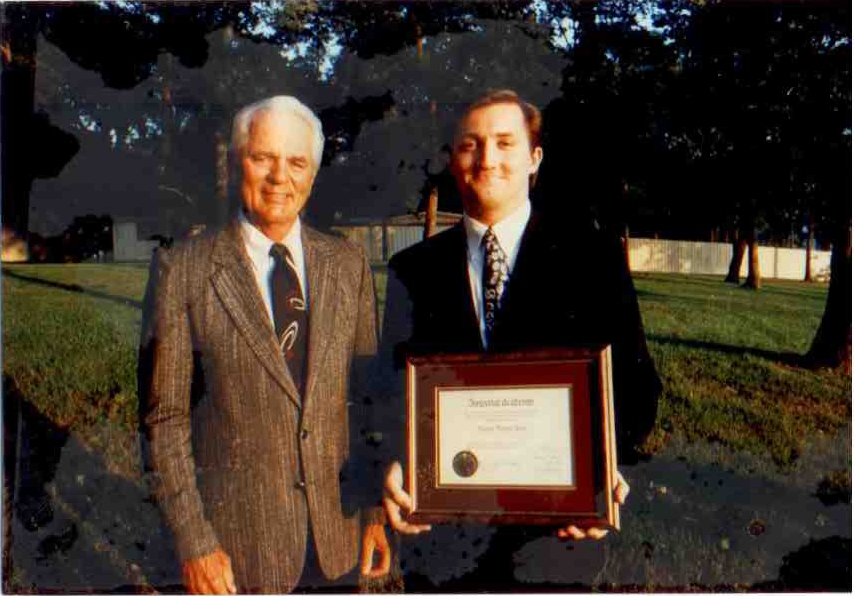
Garner Ted and Me (Photo)

I just rediscovered this water-stained photo testament of my history as an Armstrongite.

GTA had a good beer buzz going on at this moment.

This picture was taken at the graduation service of Imperial Academy in the summer of 1996. I had completed the church's two-year theological program. It was the last year Imperial Academy conducted classes full time. It was also the second year.

It was roughly three years or so after this photo was taken that I began inquiring about Catholicism.

Sunday, July 08, 2007

Mystery of the Racist

The Catholic Church, as its ancient name implies, makes no distinction between ethnicity and the races. Racism is unwelcome in God's house.

On the other hand, it was taught in the house of the late Herbert W. Armstrong, founder of the Worldwide Church of God, in which I was reared.

I've been reading the blog Shadows of WCG almost every day since it began a few months ago. Its young, prolific author "J.," an ex-WCG member, offers a daily critique of historical Armstrongism. I don't have the time or interest to delve into all that "J." does, but every morning I still like to see what's on his mind.

HWA's racism
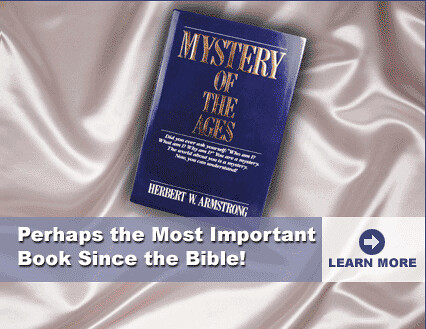
Because of "J.'s" blog, I recently blew the dust off my copy of Mystery of the Ages, which HWA considered his finest work, and which his posthumous devotees revere. The Philadelphia Church of God, true to HWA's review of his own book, advertises the book this way on its home page:


I marked up my copy of the Philadelphia Church of God's reprint of HWA's book, because it's astounding what his followers let him get away with. One absurd theme (out of many) I've seen in this book is racism.

Here are some choice quotes, with all emphases by the original author. Not all of them are blatantly racist on their own, but through them as a whole, in their context, HWA's racism is unveiled at last! (Does the "W" in HWA stand for "whitey"?)
There was rampant and universal interracial marriage -- so exceedingly universal that Noah, only, was unblemished or perfect in his generations -- his ancestry. He was of the original white strain. . . .

It is evident that Adam and Eve were created white. God's chosen nation Israel was white. Jesus was white. . . .

The one man God chose to PRESERVE the human race alive after the Flood was perfect in his generations -- all his ancestry back to Adam was of the one strain, and undoubtedly that happened to be white -- not that white is in any sense superior. . . .

God intended to prevent racial intermarriages. But man has always wanted to violate God's laws, intentions and ways. . . . As mentioned before, God had set the bounds of the races, providing for geographical segregation, in peace and harmony but without discrimination. . . .

God had intended geographical segregation, not integration of the races. . . .

The probability is that these people [the ancient Hebrew nation] were all -- or nearly all -- of the white racial strain, unchanged since creation. . . .

Undoubtedly, one reason [one purpose for choosing Israel] was to preserve the original physical racial strain. . . .

God had chosen a nation of almost perfect original strain in its generations -- its ancestry. Also they had the quality heredity of Abraham, Isaac and Jacob (Israel). . . .

Here was a people of almost clear racial strain, and the God believing heredity of Abraham, Isaac and Israel. . . .

God started his chosen nation off -- even though brought out of slavery -- with all the natural advantages of a superior heredity. God pulled them out of slavery and gave them a new and fresh start. One might say they had everything God-given going for them. . . .

The nation Israel under Moses was ONE RACE -- very little interracial marriage had marred their racial nationality. . . .

The Promised Land was then called Canaan. Canaanites, racially dark, had settled in the land. . . .

GOD INTENDED TO KEEP THEM PHYSICALLY SEPARATE from other nations -- both nationally (racially) and religiously. . . .

Jesus Christ was born of the tribe of Judah, and it was necessary that HE be of the original pure racial strain, even as Noah was.
The following quote is in the context of what the eschatological kingdom of God will be like, after the resurrection of the saints who will rule over humans on this earth. In other words, this is what paradise will be like:
It seems evident that the resurrected Noah will head a vast project of the relocation of the races and nations, within the boundaries God has set, for their own best good, happiness and richest blessings. This will be a tremendous operation. It will require great and vast organization, reinforced with power to move whole nations and races. This time, peoples and nations will move where God has planned for them, and no defiance will be tolerated. . . .
HWA just identified himself as the "Elijah to come" (whom John the Baptizer only foreshadowed), in addition to being the plain ol' end-time "apostle," before writing,
Also the indication is that the teaching of spiritual truth -- of the true gospel, the spiritual conversion of the world -- will be directed, worldwide, from this Headquarters Church, under Elijah and the overall direct supervision of Jesus Christ. . . .
Jesus is in trouble if He appoints HWA in the kingdom to be the teacher of truth -- the same guy who wrote that the Israelites were white, "not that white is in any sense superior," and a few pages later wrote that God gave ancient Israel "all the natural advantages of a superior heredity."

Absurdity abounds in Mystery of the Ages, and it's sad that people still promote the book on television and in Wall Street Journal ads. I remember when the current leadership of the Worldwide Church of God (who now rejects HWA's teachings) first pulled the book out of circulation because of certain errors they had intended to edit. HWA's hardcore followers were outraged.

The continued arm hold of Armstrongism
Today, some moderate Armstrongites ("Reformed Armstrongites," as some like to be called) will admit that HWA had some few things wrong here and there -- that some of his teachings could have been explained a little differently, that his arguments could've been tighter, that he didn't have the theological sophistication to explain the "truth" in precise terms -- but they insist his main teachings were correct (Saturday Sabbathkeeping; avoidance of "unclean meat"; soul sleep; Trinitarianism is a satanic doctrine; Christmas and Easter are pagan abominations; Jesus' Second Coming has been imminent since at least 1934, and how much more imminent is it now!; man's destiny is to become Gods -- each person will become a God; etc.).

But even the moderate Armstrongites cannot escape the powerful psychological and spiritual grip of this man, this demonstrably false prophet. They prefer the comfort of being under the cool, dark "Shadows of WCG." They don't want to see the harsh light, because it would hurt too much. It would be too painful to admit that their years of sincere devotion to a belief system was in vain.

I say it was "in vain," but I don't mean to say it's unredeemable. While I let go of HWA's teachings as a fairly young adult, I grew up chin-deep in his church. I am thankful for the lessons and unique perspective that I have as a result. It may not sound like it sometimes when I rant, but I do have compassion for those who cannot leave. They really don't know any better. And sometimes when they almost do, they turn their head -- they turn back like Lot's wife.

They need the prayers of Catholics and all other Christians to find the strength that God has already given them to leave Armstrongism behind and to embrace the truth -- not the "plain truth," but the glorious Truth that is Jesus Christ.

It's clear to us now why the current WCG leadership could not merely edit HWA's book; it had to be abandoned. And its abandonment is no mystery for the ages. It was simply the right thing to do.

Monday, July 02, 2007

A False Prophet Nails Himself


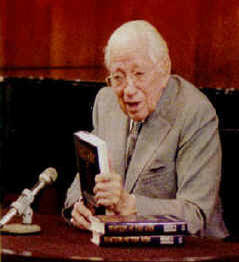
As one with a background in Armstrongism, I was intrigued by this quote from Herbert W. Armstrong, made several decades before his death in 1986. I've read the quote before, but it's more astonishing to hear it in his own voice. This quote is found at approximately 68:30 on the timer (less than 5 minutes into the video):
I want to tell you that all this weather disturbance means a terrible famine is coming on the United States, that is going to ruin us as a nation inside of less than twenty more years. All right, I stuck my neck out right there. You just wait twenty years and see whether I told you the truth. God says, if a man tells you what's going to happen, wait and see. If it doesn't happen, he was not speaking the word of God, he's speaking out of his own mind. You watch and see whether these things happen. You see who's speaking to you, my friends.

I am sure that his strongest modern-day apologists might defend him by disagreeing with him on that point.

I think this lengthy video would interest current Armstrongites, ex-Armstrongites, and those who are curious about the story of the Worldwide Church of God. Don't get me wrong -- I'm not a big fan of the current WCG -- but this is still fascinating.

Monday, May 28, 2007

Why Only Pentecost?

Why do Catholics and mainstream Protestant denominations celebrate the Feast of Pentecost, but not the other festivals listed in Leviticus 23 and Deuteronomy 16? Do we just "play favorites," simply ignoring or even rejecting Passover, Unleavened Bread, Trumpets, Atonement, and Tabernacles?

No. Keep in mind that we (at least Catholics) celebrate and meditate on key Christian events. We commemorate and rehearse things like the Annunciation; the Birth of Jesus; His Baptism; His Death, Burial, and Resurrection -- and the Descent of the Holy Spirit. We are obviously very Jesus-centered in our religion.

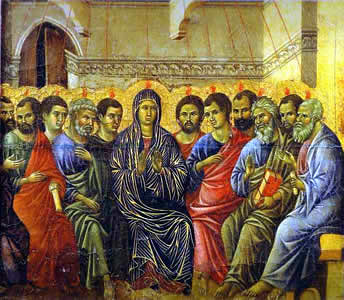
The Holy Spirit descended in a spectacular way on Pentecost. Not only did flames rest upon the heads of those who were waiting in obedience and praying with Mary, but the Spirit also lit a fire under their backsides, so to speak, and gave them power from on high to spread the gospel of Jesus and His kingdom to all nations in all the world. We celebrate, therefore, the gift of the Holy Spirit -- which is no small matter. There are innumerable lessons, teachings, and meditations to draw from Pentecost.

It is for the express Christian significance of Pentecost that we observe this day.

Israel's annual feasts
That's not to say the other Jewish festivals aren't "Christian" in a real sense. In these other holy days, there is a tremendous amount of symbolism that points us to Christ.
  • Jesus is the "Lamb of God" not because of any physical resemblance, but because He, in the place of the Passover lamb, was our true sacrifice that truly forgives sin -- not in type or symbol, but in reality.
  • St. Paul used imagery from the Feast of Unleavened Bread to illustrate the nature of sin (1 Corinthians 5:6-8).
  • Trumpets were used, among other things, as calls to assembly and to announce war-making. As Christian soldiers, we can extract spiritual lessons from the Feast of Trumpets and recall that Jesus' return to earth and the resurrection of the saints will be announced with "trumpets."
  • The Day of Atonement is fulfilled by Jesus who is our atonement. As the one Mediator and High Priest, He unites us with God.
  • Just as Israel was to observe a festival that commemorated their living in temporary dwellings when they left Egypt, so we as Christians recognize that once we have left "Egypt" (sin), we are still sojourning in a land that is not our own. We are seeking a new country, a heavenly county, our "land of promise" -- "the city with foundations, whose architect and builder is God" (Hebrews 11:10).
While these days featured shadowy glimpses of Christian realities that were to come, they were also very Israel-centric, or "Jewish." They were harvest festivals that related to ancient Israel's times and circumstances and history. Since God chose Israel from among all the other nations of the earth for a certain purpose -- in preparation of the coming of Jesus -- then naturally the pre-Christian holy days that God gave them would be about their nation and their role in salvation history. In that way, these days are worthy of our attention.

Calling all men
With the coming of Christ, however, God is calling all men (not just the nation of Israel) to Himself. It all started with the man Abraham, then the clans that came from Abraham, then the nation of Israel. Finally, it culminated in Jesus, who, with His apostles, has shared God's revelation to all the earth. God is no longer dealing primarily with one nation among all nations; He is dealing with all peoples of the earth -- including those whose ancestors did not cross the Red Sea or inherit a land of promise!

The "universalization" of God's gift of salvation, as we see in the Acts 2 account of Pentecost, is why we observe that day. It is fundamental to Christianity. It marks the inauguration of the Church, the ethnically blind instrument God is using to reach His children. Once the Church reaches these children though the power of the Holy Spirit, they become part of the Church -- they become part of Jesus' Body. And perfect union with Jesus is our eternal destiny.

For the sake of argument, if Jesus had been conceived or born on Hanukkah -- the Festival of Lights -- then surely the Church today would be observing Hanukkah, pointing out that Jesus is the true Light of the world, the Light of life, and that we should let our Light shine before men to glorify the Father. It would be for these reasons that we would celebrate Hanukkuh -- not strictly because of the rededication of the Jewish temple, the commemoration of which being the day's original, primary focus.

As an interesting aside, apparently Jesus had no issue with an "extrabiblical" religious holiday such as Hanukkah, since He was walking about the temple on that day, speaking publicly (John 10:22-31). He did not speak against it, but rather spoke to the Jews about His miracles, which arguably could be connected to the fact that Hanukkah is associated with a miracle. ("The Temple in Jerusalem was purified, and the wicks of the Menorah miraculously burned for eight days with oil enough for only one day" -- Wikipedia.) Christian lessons could easily be expounded from this. But still, it is fundamentally "Jewish," even though it does carry spiritual lessons for all of us.

Keep your "Christian focus"
One unorthodox Christian publication recently began an article with these words:
Most professing Christians acknowledge just one of God's holy days -- Pentecost. . . . But what does it mean to them? To most, it is merely a celebration of the "birthday" of the church, or a time of changing the colors of their religious robes. But the real meaning goes deeper than this. Much deeper. Pentecost is rich with symbolism. Let's take a quick overview of this God-ordained day.
The article then goes on to explain the very Christian significance of this day that you and I already understand, but the writer represents one of several movements that insist we as Christians should be observing all the Jewish festivals, and that we are sinning if we don't. Also, they condemn as pagan and sinful our celebration of clearly Christian days, such as Christmas and Easter, because they "hide" the plan of God.

But, in fact, the opposite is true: Christmas and Easter plainly reveal monumental Christian events that are absolutely crucial -- and as central as central can be -- to God's plan for man. Focusing exclusively on the holy days of Israel and rejecting Christian holy days can lead to many theological deficiencies which, potentially, can distort the Christian message.

Note, also, how these same preachers and writers characterize Catholics (and mainstream Protestants) as "professing Christians" (not true ones) who blindly follow empty traditions and are superficially concerned with wearing right-colored robes. But you should know better than that.

They would have you limit your observances to shadows and not the realities. They would have you be like the hungry dog who only sniffs and looks at his master's finger, oblivious to the fact that the finger is pointing to a bowl of fresh-mixed Gravy Train.

Be prepared. Learn your Faith. Read the Bible. Read the Catechism. If you have questions about challenges to the Faith, search for answers. Ask someone who can shed light on these challenges.

Don't fall prey to false teachers. Instead, fall down and pray -- that you may be made worthy of the promises of Christ. And praise God for sending us His Holy Spirit, who was given to the Church two thousand years ago on the day of Pentecost.

Monday, April 30, 2007

Suppertime Sin?

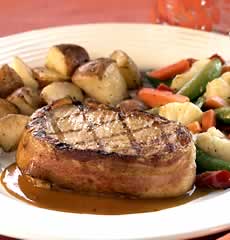
Have you ever sat at the dinner table in front of steamed veggies, a lean and seasoned pork chop, mashed potatoes, and a cold glass of milk, wondering whether consuming this meal is sinful -- opposed to Christian teaching?

Some Christians, for religious reasons, object to that lean and seasoned pork chop being on the dinner table. Citing Leviticus 11 and Deuteronomy 14, they insist that it is "unclean meat," which God forbade the ancient Israelites to eat. That much is true -- God DID command them to avoid certain meats. But do these laws pertain to Christians -- now?

I thought they did. I was raised in a church that taught it was a sin for a Christian to eat pork, lobster, shrimp, catfish, and a host of other foods. I believed that to do so was to disobey God's instructions, and that it was the cause for numerous health problems in society. Listing various "clean" and "unclean" meats, the Bible presented us with a divine diet. I believed it was the Maker's menu for the health of humankind.

When I was older, however, I reached another conclusion. Based on a more fair and critical examination of Scripture, I came to understand the historic Christian understanding of these and certain other laws -- that they were given to a particular audience and were not intended to apply universally to all societies throughout the ages.

Very simply, in the interest of time (and your attention span), here is my belief regarding clean and unclean meats:

While it is possible that unrecorded health issues of the time were included, God gave Israel their dietary laws as a sign or reminder that He separated them from among the other sinful nations to be His people. Since God is no longer dealing primarily with the nation of Israel, but calling all nations to repent and to be His people, the laws that distinguished Israel from her neighbors have served their purpose. They do not directly pertain to our circumstances, and therefore serve no practical purpose now.

Wherever these clean and unclean meats are discussed in Scripture, the reason for them is either implied or explicitly stated. It is most clearly stated in the following passage:

Leviticus 20:24-26:
I am the LORD your God, who has set you apart from the nations. You must therefore make a distinction between clean and unclean animals and between unclean and clean birds. Do not defile yourselves by any animal or bird or anything that moves along the ground—those which I have set apart as unclean for you. You are to be holy to me because I, the LORD, am holy, and I have set you apart from the nations to be my own.
As Christians, we are free to choose to avoid certain meats (or even all meats) based on conscience and nutritional views. It is a mistake, however, to claim biblical authority for demanding that catfish dinners be banished from the Christian's menu.

Saturday, April 28, 2007

Passover and Easter

The Bible does not stand alone as a victim of sloppy interpretation. Most any text -- some more easily than others -- can be misread and misunderstood.

I recently received a comment on one of my older posts. The commenter undoubtedly believes that Easter is a pagan holiday to be avoided, and that Christians instead should observe the "Lord's Supper" only on the night of the Jewish Passover.

Because I find it valuable to examine the beliefs of the Early Church, the commenter posted a quotation from ancient historian Eusebius (pictured above), who cited a letter from Polycrates to the Roman bishop Victor. Polycrates, based on a tradition he says comes from the apostle John, insisted on observing the date of the Jewish Passover, while Victor insisted on maintaining the Sunday observance for Easter. Earlier that century, Polycarp had the same argument with Anicetus.

The anonymous commenter concludes, "So now, who left the teachings of the first generations of Christians?"

I am sure the commenter overlooks certain points when reading this account from Eusebius' History of the Church:

  1. It's evident that there was a certain kind of authority or primacy associated with the bishop of Rome -- both Victor and Anicetus. Why did Polycrates and Polycarp insist on talking to the Roman bishop unless he had some sort of widely recognized authority in church matters? It also appears the Roman bishop had the authority to excommunicate whole parishes and regions from the faithful. (Note: This is long before Constantine and the Council of Nicea of A.D. 325.)
  2. The whole controversy was over specific dates, not specific celebrations. The truth is that they debated when to celebrate a special annual observance of the the death, burial, and resurrection of Jesus. Both sides of the controversy were speaking of the same event, but argued over when it was to be observed. It was not "Should we keep 'God's Passover' or 'pagan Easter'?" There is no evidence that the pope was trying to force a new celebration upon Christians. Thus there was no outcry against colored eggs, Cadbury bunnies, or pagan accoutrements (secular, modern "Easter" symbols didn't arrive till much later).
  3. Polycrates and the others Asiatics on his side also observed a form of Lent. The length of "the fast" leading up to Easter (or Passover, whichever you wish to call it) also varied according to different traditions. But, unlike the anonymous commenter, they still observed this already ancient tradition.
  4. Despite their differences, after their visit, "Anicetus conceded the administration of the eucharist in the church to Polycarp, manifestly as a mark of respect." If Polycarp thought Anicetus was falling headlong into paganism, why did he agree to administer the Eucharist? By the way, because of their strong views, surely this particular Eucharistic celebration was held neither on the Jewish Passover date nor on Easter Sunday. It would have been an ordinary weekly Sunday, which was a customary practice for both of them.
There are other things I would like to point out, but not knowing for sure who the anonymous commenter is, I don't know which points to address.

To read about this in fuller context, read all of chapter 24 in Eusebius' work here.