Tuesday, May 08, 2007

The Rosary: A Chain of Events

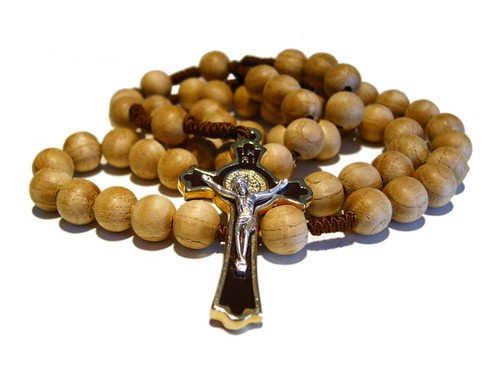
I briefly discussed the Rosary before ("Not All Repetitions Are 'Vain'"), but I want to clarify another aspect of this cherished Catholic prayer.

The first time I arrived early for Mass and witnessed a large group of parishioners reciting the prayers of the Rosary in unison, it struck me as almost haunting. Everyone was kneeling, thumbing their beads, and vocalizing ready-made prayers in a collective monotone voice that echoed throughout the church.

I wasn't used to that at all. It sounded almost pagan . . . whatever "pagan" sounds like.

But it all makes sense when you realize what's really happening. The Rosary prayers are not to be empty-headed recitals -- but quite the opposite! They are to be prayed with a full head of gospel meditations! The one who is praying should (ideally) have his mind focused on one of the "mysteries" (i.e., revealed truths) of Christianity.

Thursdays, for example -- like today -- are typically set aside to meditate on the "luminous mysteries," which are events from Jesus' earthly ministry. They include:
  1. The Baptism in the Jordan
  2. The Wedding at Cana
  3. The Proclamation of the Kingdom of God
  4. The Transfiguration
  5. The Institution of the Eucharist
In other words, during the first set of the "Hail Mary" prayers, which an outside spectator may mistake as dull and vain, the pray-er in reality is heart-deep in meditation on Jesus' baptism in the Jordan.

He may be pondering the importance of baptism, and how it is the normal entry gate to salvation through Jesus Christ; he may be imagining how John the Baptizer must have felt baptizing the Lord; he may be "listening" to John's words, "Behold, the Lamb of God, who takes away the sins of the world"; he could be placing himself at the scene, so to speak, to witness the Holy Spirit descend on Jesus as a dove, and listening to the words of the Father, whose words resounded from heaven: "This is my beloved Son, with whom I am well pleased"; he might be piecing together this baptism, which was done as our example, with the "born again" conversation Jesus had with Nicodemus -- found just two chapters later in the Gospel of John.

With just ten "Hail Marys" per mystery, time flies by quickly. I've caught myself going much more slowly when I notice I'm near the end. Oftentimes, the only way you know it's time to go to the next set (unless you want to continue that meditation) is when your fingers and thumb encounter the larger, "separator" bead. Then it's time for the next set -- that is, if you're ready to move along.

The reason the vocalized prayers sound either hurried or "dreary" to some is that the one who's praying is focused on the meditations and not on making colorful voice inflections. With practice, the combination of vocal prayer and meditative prayer has a way of harnessing your full attention.

Imagine the benefits of daily recitation of the Rosary. It's a prayerful rehearsal of the whole gospel story. Impure thoughts of any brand are replaced by the scenes of salvation history, revealed to us by Scripture and the Tradition of the Church.

What better way to purify your mind on a daily basis?

Save Over $10 on Offical U.S. Catechism

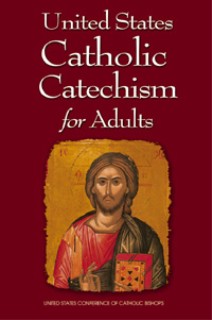
If you go to your bookstore to buy the United States Catholic Catechism for Adults, you'll pay $24.95 plus tax (plus gasoline if you have to drive far to get it).

I got mine for a little over $15. You can, too, if you order by May 15.

I don't mean to sound like a cheesy salesman, but I know I would appreciate the tip:

Go to Adoremus Books to get it. Now, here's the catch -- you get $10 off if you sign up for a Google Checkout account. This discount is only good for first-time users of Google's answer to "PayPal."

Paying with Google Checkout brings the price to $14.95. If your total order is at least $25, you get free shipping. So I bought a 50-cent plastic ruler to bump it over $25 (before discount). That means my final cost was $15.45 -- saving at least $10 compared to driving to the book store.

My plastic ruler arrived broken, but I didn't complain. I was more interested in reading about the Eternal Ruler.

Monday, May 07, 2007

Sit, Stand, and Kneel (Rosary Army)

This is an informative, somewhat humorous and entertaining video -- about five minutes long -- that explains why Catholics sit, stand, and kneel at Mass. Produced by our friends at Rosary Army, this is the first episode of the video podcast, That Catholic Show.

Sunday, May 06, 2007

Spidey and His Web of Faith

(BEWARE: The following post may spoil the movie for you if you haven't seen it yet.)

Last night I watched Spider-Man 3. I give it all eight thumbs up -- not just for its amazing action, but for its Christian themes. I did some World Wide Web-crawling of my own, and apparently I'm not the only one who saw Christian elements within. In this movie, it's just plain obvious.

Spider-Man 2
When I saw Spider-Man 2, I detected what I thought to be Christian imagery. In this movie, the miracle-working Web-Head fell out of favor with the populace, the hearts of which were hardened against him.

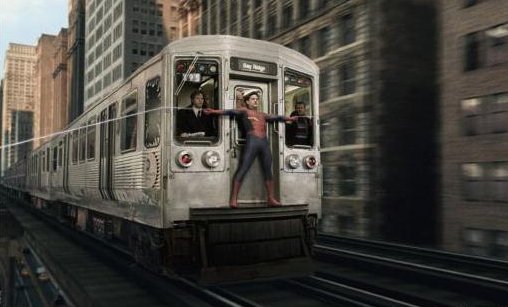
But Spidey loved them while they were yet sinful citizens, and he was willing to sacrifice his life to save them from a train wreck. The method he employed to do this was with arms outstretched and his hands bound, enduring great pain and suffering by his own free will. Notice, too, the hole in the side of his costume.

True, this is all cruci-fiction, but there is nothing fictitious about what it portrays: the power of love. The passengers' ride on the Gospel Train was a turning point in the movie.

The Web-Slinger acted as a selfless savior. As shown in the picture, He was fully Spider-Man and fully Peter Parker, one person with two natures. He collapsed as if dead, and then "came back to life," as it were, when he regained consciousness before a host of witnesses in the train, who came back around to believe in him.

Spider-Man 3
In the third movie, which I just viewed, I saw Peter Parker acting out the Christian life.

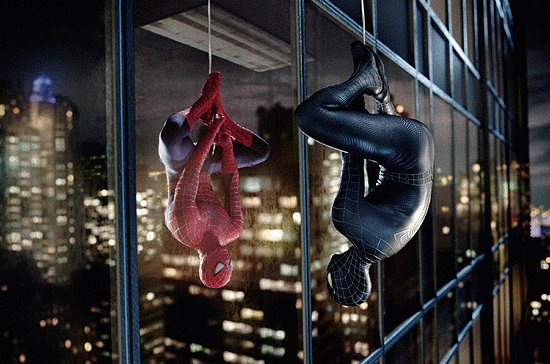
Because of his successful crime-fighting career and all the accolades he received, Parker swelled with pride. This opened the door to sin's overpowering darkness, represented by the black, creepy-crawly extraterrestrial symbiote that enveloped him and increased his capacity for doing evil.

His conscience, however, was a law unto itself. Despite the gravity of his sins, something inside tugged at him. Finally, when he hit his low point (when he hit his beloved Mary Jane), he felt a strong conviction, realizing what kind of monster he had become.

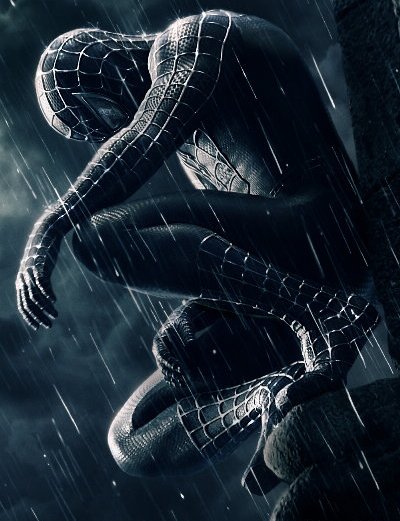
When he stepped outside, he gazed upon the cross. This cross was at the top of a nearby church -- a Catholic church, I might add. He webbed his way up the church and sat prayerfully on the side of the church tower underneath the cross.


He then entered the structure and attempted to tear off the black "sin-biote" that had overtaken him. He was successful only during the sounding of church bells, which symbolize a call to worship.

It seemed odd -- but fascinating to me -- that, immediately following the church scene, Peter Parker basked in and found great comfort in taking a shower. It looked like a deliberate reference to the cleansing waters of baptism, after which his repentance continued to deepen.

Some time after Peter's sacramental shower, the real killer of Uncle Ben offered a confession of his murder to Peter. After the killer expressed remorse, both were in tears, and, as if serving a priestly function, Peter confidently spoke the words, "I forgive you." The killer went away knowing he was truly forgiven.

We also saw two people who died in the end: one who repented and one who did not:
  1. Harry, who had been Spidey's enemy, changed his heart and became Peter's friend again. It turned out as was foreshadowed earlier in the film: he gave his life for Peter.
  2. The other person, Brock (or "Venom"), loved the sin of the symbiote that attached itself to him after Peter had ridden himself of it. Brock had full opportunity to be freed from the symbiote, but as it was about to meet its end, Brock ran toward it and thereby shared in its fate of incineration -- a type of hell.
Even the shadiest of moviegoers find themselves at least inwardly rooting for Peter Parker to triumph over evil in all its forms, whether they be outside forces or internal temptations.

For no matter who we are, we all admire goodness and the integrity of truth. What not everyone realizes is that Jesus is the embodiment of truth, and that as Catholics we are blessed with the full revelation of that Truth.

As we reflect on this, we are provided with plenty of reasons to Marvel.

Thursday, May 03, 2007

"Routine-istic"


I think she blended "routine" with "ritualistic."

My Filipino friend was explaining why she became Baptist after moving to America a few years ago as a lifelong Catholic, citing routine Catholic rituals that didn't hold her interest. Her parish went through the same old things week after week.

Her new Baptist church, on the other hand, studies the Word of God and offers a warmer, friendlier environment, she says in so many words.

For me, at least, it's hard to reason with someone wooed by the warmth of a good Southern Baptist church without sounding argumentative or academic. I understand that not everyone who betrays her Catholic Faith is a victim of the warm fuzzies, but for those who are, I'm at a loss for words. While there's little I can say, of course there's much I can pray.

Still, I consider what my friend said, and I end up explaining it to myself in a way I can understand. (It's all about "cultivating the Catholic conscience.")

First, the Catholic Church is the premiere "Bible Church." It's the Church that preserved the Bible, canonized the books of the Bible, and exists as the Church of the Bible. We are engaged visually by the biblical scenes portrayed in works of art. We are engaged auricularly as we hear the numerous readings that systematically work their way through the Word of God, the Bible. And, most importantly, we are engaged spiritually by literally communing with the Word of God through the Real Presence of the Eucharist.

If you're looking for a solid "Bible study" -- examining the depths of Holy Writ -- then there are many such Catholic Bible studies. It's just not the goal of the divine liturgy. Mass is a class, but for the spirit and not necessarily (although sometimes) for the intellect. That's what Wednesday- and Sunday-night Bible studies are for. You cannot read the works of Catholic writer and teacher Scott Hahn, for example, and claim that Catholics have little to offer those who hunger for in-depth Bible study.

If you're looking for social networking, you can go to any number of your parish's activities -- but Mass is not the live Catholic version of Yahoo!'s "Chat Central."

You can find friends and studies easily enough as a Catholic, but most importantly you get:

  • All the sacraments, notably the Eucharist and Reconciliation
  • Bishops and priests who are given authority to say Mass
  • The pope, successor to St. Peter, the "rock" upon whom Christ built His Church, who shepherds the "Church militant" (i.e., the Church on earth)
  • Authentic teaching handed down by the apostles, preserved and codified by the Church's Magesterium throughout its history

Yes, it's easy to get hooked on a religious feeling, but why not seek to be reeled in by the Truth who will set you free?

I'll pray that my friend returns to full communion with the Church, which, in obedience to Jesus' ancient instruction, goes through the "same old things week after week": celebrates Mass (1 Corinthians 11:23-26).