Saturday, September 10, 2005

Miscellaneous Thoughts

These are some random, miscellaneous thoughts of minimal importance, but I wanted to jot them down just for me.

Changing Doctrine?

If the apostles thought Jesus would return in their lifetime, does that mean the Church's teachings have "changed"?

No. I say Jesus' imminent return was something that was speculated about, and believed by many, but not the official teaching of the Church, not to be included in the deposit of faith that was to be believed by all Christians.

"Progressive Revelation"?
I viewed a sermon by a Church of God International minister who said we know things today that the authors of the Bible didn't understand fully.

Does that mean there is new revelation? Or does it mean, as the speaker said, that we have the benefit of looking through the spectrum of history and are able to see a clearer picture of "truth"?

That's what the Catholic Church believes about her own doctrinal clarifications and defined dogmas. Catholics believe that public divine revelation ceased at the death of the apostle John, but that the Spirit guides us into all truth, continues to help us deduce insights based on previously defined revelation.

Did God "Call" You?
In the same CGI sermon mentioned above, the speaker maintains that those who know the "truth" about the seventh-day Sabbath, the holy days, the mortality of the soul, prophetic scenarios, etc., have been called and drawn by God. The billions of others on this planet have not been "called" and are not being judged now, he says.

Yet, later, he quotes the scripture that says many are called but few are chosen, and he says that even though many are drawn and receive the same calling, those who are "chosen" are those who respond to this calling.

How is this so different from Catholic teaching, that we are judged according to how we respond to the light that we are given?

The CGI minister wants to simultaneously hold on to his church's traditional teaching (only those with their understanding are "called") and to what commonsense biblical teaching is (the "chosen" are those who respond to God's call). It is a contradiction, but he has a hard time letting go of his church's tradition

Still a Hypocrite?
I've heard it argued that a person can't "preach" to someone else about morals if the person has been guilty of the failing himself.

Example: If a father tells his son that he is not to smoke marijuana because it is harmful and illegal, can the son rightly ignore his father's instruction if it is known that the father tried it when he was younger? Does that make him a "hypocrite" with nothing to offer?

Notice Matthew 7:3-5:
Why do you look at the speck of sawdust in your brother's eye and pay no attention to the plank in your own eye? How can you say to your brother, "Let me take the speck out of your eye," when all the time there is a plank in your own eye? You hypocrite, first take the plank out of your own eye, and then you will see clearly to remove the speck from your brother's eye.
It makes sense to me that a person can learn from his mistakes and sins by turning away from them, and then he is able (obliged) to help others. A father with a dubious past can indeed (and in fact must) pass along his wisdom to his son, even if the wisdom was acquired at the school of hard knocks.

A hypocrite is a person who preaches one thing and does another, but a person who conforms his actions with his preaching repents of the sin of hypocrisy, and is therefore no longer a hypocrite. He is now able to see clearly enough to take the speck out of his brother's eye.

In any case, correct moral teaching is still valid, no matter who speaks it.

"Call No Man Father"
The link to this article comes from Karl Keating's e-letter. It is an article written for The Christian Century in 1985. The article is titled "Are 'Mother' and 'Father' Appropriate Titles for Protestant Clergy?" The author is David L. Holmes, who teaches in the religious studies department at the College of William and Mary.

This explains that the title "Father" was used even in American Protestant circles in earlier centuries.

Saturday, August 06, 2005

Ceremony for Ceremony's Sake?


"I don't like ceremony for ceremony's sake," said a Baptist friend of mine in reference to the Catholic Church's liturgy. I smarted off something in return, but should have given a more thoughtful reply. Something like this.

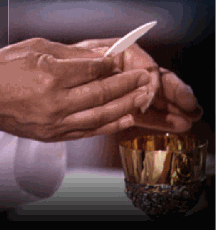
The Real Presence of Christ is why the Church conducts its liturgy with such formality and reverence.

It makes perfect sense. I'm not arguing it here, but if it is true, as the Catholic Church teaches, that Jesus is really and truly and substantially present in the Mass, then there's no other way to be but "formal."

In many if not most non-Catholic Evangelical churches, a worship service finds its climax in the pastor's sermon. At least, that is the most "serious" part -- the time when one is expected to be most focused. (It's when you smack the kids and tell them to sit up straight and be quiet.)

The Catholic Church is different. Her liturgy leads up to a more profound summit.

The Church believes Christ is present in four ways at Mass:
  1. In the congregation. Where two or more are gathered in His name, Jesus is present.
  2. In the liturgy of the Word. The spoken Scripture readings from the Old and New Testaments, as well as the biblical psalms and prayers, are heard as if they were from the lips of Jesus. Scripture is God's special communication to us. It is God speaking to us.
  3. In the priest. The priest acts "in a Jesus way." Through the sacrament of ordination, his soul is indelibly marked. He IS a priest. He is not just performing menial table duties that anyone can do; he fulfills what he really is, for Jesus has shared His own Priesthood with him. The priest, in this way, acts or stands in for Christ. When the priest conducts his priestly duties in celebrating the Mass, it is Jesus standing up there spiritually.
  4. In the Eucharist. This is the fullest, most profound, most true, most "real" kind of presence -- hence its popular name, "the Real Presence."
The Mass, then, finds its climax in the Eucharist. Its celebration is the highest form of worship possible on earth. All other segments of the Mass lead up to the Eucharist (not to the sermon).

The Church believes that, in the celebration of the Eucharist, ordinary bread and wine actually become the true Body and Blood of Christ (not in its appearance, but in its essence), whereas most non-Catholic churches teach that the bread and wine of their "communion," or "Lord's Supper," or "New Testament Passover," etc., are mere symbols that only remind us of Jesus' 2000-year-old sacrifice. Catholics believe that the once-for-all sacrifice of Jesus is presented to God at the altar, and that its power is again applied to us, for we are still all sinners needing God's graces even after accepting Christ as our Savior.

Arguments for or against the Real Presence aside, the fact is that Catholics believe it. And that explains why the Mass is conducted with solemnity.

It also explains why the Mass is seen by many non-Catholics as "ceremony for ceremony's sake." Understandably, they can't relate to anything other than their own experience, for the non-Catholic view of "church" is usually just a place where like-minded believers can fellowship and encourage each other. They listen to the Word of God expounded. They worship God in prayer and song.

Sometimes this kind of limited worship can end up being too folksy. It's almost as if Jesus is our Pal, our Buddy, a heavenly Good Ol' Boy strumming an acoustic guitar with a blues harp in His back pocket. Jesus loves you as you are. And He's most comfortable wearing a tank top, cut-off shorts, and flip-flops.

Catholics also believe Jesus loves us and accepts us all as individuals at the most intimate level. Yet we go on to correctly emphasize that Jesus, in addition to being the lover of our souls, is the King of kings and Lord of lords. He is the Creator that sustains the existence of all things, whether in heaven or on earth. If God did not have us in His mind, we would instantly vanish from existence -- just as quickly as we leapt into existence by His spoken Word.

When we recognize this infinite chasm between the all-powerful, all-loving, life-inherent God of the universe and us puny, sinful humans, we can do nothing but worship Him with awe.

And if the Word of God who created us is literally present on the altar at Mass, we are obliged to act as if His presence is more significant than that of Roy Clark or Buck Owens and the Buckaroos. Jesus is supreme majesty. He is holy, holy, holy -- the Lord God Almighty.

No society is a stranger to ceremony. We have no problem with funerals, weddings, presidential inaugurations, the presentation of medals of honor, etc. So is it then okay -- no, obligatory -- to treat the presence and procession of the Son of God with even more reverence?

Whether Jesus is truly present in the sacrifice of the Mass is what we should ask. The Real Presence is the real question. I'll steer you toward this link, which contains good articles and audio clips that explain the Real Presence of Christ in the Eucharist.

Thursday, July 28, 2005

Do You Want to Come Home?


"We are all sinners." It's a Christian cliche that's worn to tatters. When it is proclaimed, eyes roll, shoulders shrug, and ears close. It's reflexively dismissed as religious gobblety-gook.

Yet understanding this fact is the essential first step toward reconciling with the Creator of your soul. In other words, you need to accept that you're at odds with your heavenly Father before you can begin your journey "home."

The proverb condemns the "adulteress" for her denial:
This is the way of an adulteress: she eats, and wipes her mouth, and says, "I have done no wrong" (Proverbs 30:20, RSV-CE).
The imagery here is almost obscene if you let your mind wander, but it illustrates how there are some who, whether because of poor moral formation or force of habit, have no sense of remorse or even acknowledgement of their sins. You know people like that. Perhaps you feel you are a people like that sometimes.

Searing one's conscience is dangerous; it is evil. A person who persists in sin disposes himself toward eating, wiping his mouth, and saying, "I have done no wrong." This very denial of sin is flirting with true human evil.

Christian psychologist M. Scott Peck says that
it is necessary that we first draw the distinction between evil and ordinary sin. It is not their sins per se that characterize evil people, rather it is the subtlety and persistence and consistency of their sins. This is because the central defect of the evil is not the sin but the refusal to acknowledge it. (People of the Lie, p. 69; emphasis mine).
The prodigal in Jesus' parable of the lost son (Luke 15:11-32), after disregarding his father's inheritance through wild and sinful living, was finally able to see himself for what he was: a sinner.

"Father," he said, "I have sinned against heaven and against you. I am no longer worthy to be called your son."

It was only after the prodigal was willing to be honest and confess his sinfulness that he could return home to the open arms of his father.

Our heavenly Father is always awaiting our return with open arms, for "[i]f we confess our sins, he is faithful and just, and will forgive our sins and cleanse us from all unrighteousness" (1 John 1:9).

Do you want to come "home"? Do you want to finally harmonize your life with God's will? Do you want to fulfill your incredible human potential?

Stop playing games, and admit your faults. Don't cover your sins -- that is God's job. And be willing to let God not only "blot your sins" from a legal record book, but cleanse you from the inside out.

It will cost you your pride, your passions, your wants, and your will. Maybe even your life. Confronting and confessing your sins will hurt, but if you can search your soul and find it within you to surrender your all to Him, God will heal you. He will welcome you home with open arms.

Tuesday, July 19, 2005

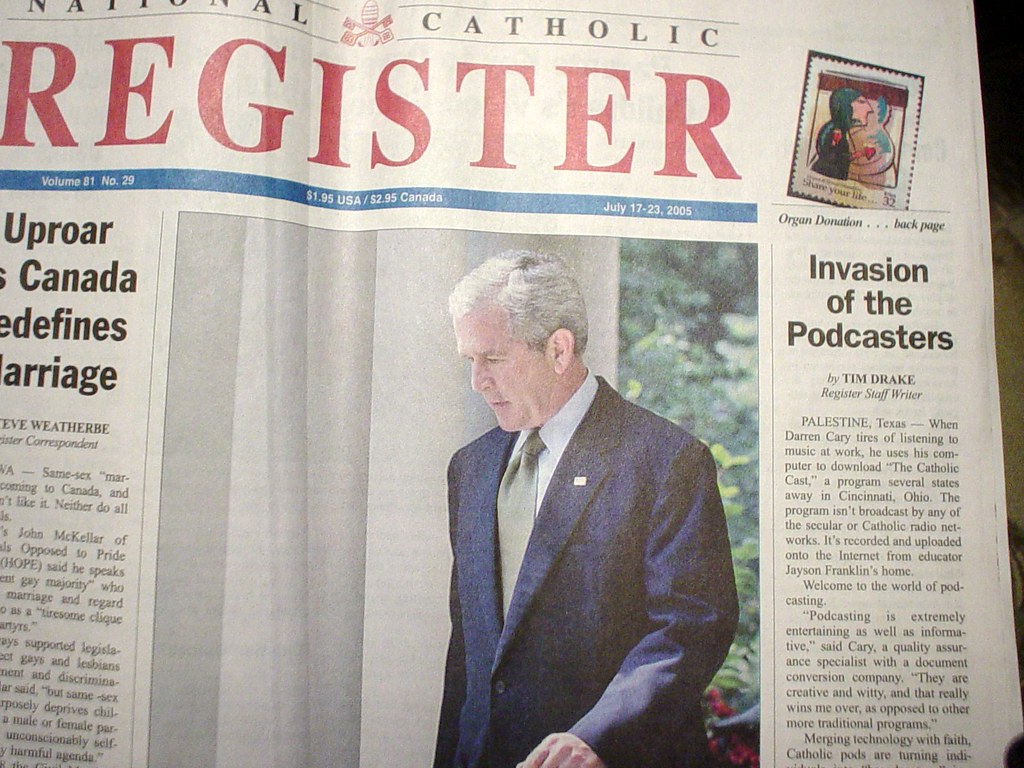
On Front Page of The National Catholic Register

Tim Drake, staff writer of The National Catholic Register, did a story on Catholic podcasting. As part of his story, he wanted to pull a few quotes from a regular listener, so he interviewed me by telephone.

Yes, I'm shamelessly showing off my name. Click here to see a close-up of this issue's front page of The Register. Click here to read the entire article online.

I happen to think it's cool to be quoted in this newspaper, but what is cooler is the podcast phenomenon, my favorite podcast being "The Catholic Cast." Check it out and enjoy each week.

Sunday, July 17, 2005

It's Hard to Be Pope


I don't think it's easy being infallible in matters of faith and morals.

I find the Papa Ratzi Post to be a good source for news on Pope Benedict XVI, and sometimes I wonder how he handles the "stuff" that is thrown at him.

A professor of Feminist Theology at the Graduate Theological Union in Berkeley, California, has reportedly announced that the Pope is "not our pope" because, I'm guessing, he upholds the consistent Catholic teachings about the all-male priesthood, about contraception, and about abortion. I didn't read much into the story because I have no interest in it. But I have to wonder: Based on these issues, have any popes been "our pope"?

Others have problems with his stance on evolution. Pope Benedict XVI said,
The purpose of our lives is to reveal God to men. And only where God is seen does life truly begin. ... We are not some casual and meaningless product of evolution. Each of us is the result of a thought of God. Each of us is willed, each of us is loved, each of us is necessary.
Benedict simply believes that God is "maker of heaven and earth," but does not attempt to scientifically explain Creation. Whether God created all things as they are in six 24-hour periods, whether He guided an evolutionary process to bring us about, whether He used a huge stork to fly a diapered Adam to this earth -- it doesn't matter. The fact remains that God willed each of us into existence.

A critic, however -- a liberal Catholic named Andrew Sullivan -- wrote,
Now we have Benedict in charge and the rush back to the Middle Ages, already seen in fundamentalist Islam and fundamentalist Protestantism, looks as if it is going to be endorsed in the Vatican. I expected reactionary radicalism from Benedict. But this kind of stupidity? ... And so we return to the 19th century.
I don't understand such reactions, other than to say they surely come from the unfaithful. What sound-minded Christian believes Benedict's view on Creation is "reactionary radicalism"? How is that "radical" coming from a pope? Does it contradict the Church's constant teaching? Would it be more in keeping with Catholicism to say, "Who knows how we got here? It's probly all just a big accident an' stuff"?

Should it surprise us if the pope is Catholic? Absurd!

I would be tired of all the crazy criticisms if I were Pope Darren. I'd be tired, oh so tired. No wonder popes -- when they aren't sitting down -- have to walk around using that "pope pole," that sceptre or staff with a crucifix on top. They would never get anywhere without leaning on the cross of Christ.