
Monday, June 25, 2007


Saturday, June 23, 2007
Blair, Which Church?

It's been rumored widely that UK's Prime Minister Tony Blair is considering conversion to the Catholic Church. (I just learned this.) My understanding is that he has been a nominal Anglican, but that he has close ties to the Catholic Church.
If true, this is great news. It is good when anyone comes "home" and is fully united to the Church that Jesus built -- the very Body of Christ.
Troubling, however, are the rumors that Mr. Blair, while not yet Catholic, has already been receiving Holy Communion regularly. Priests that permit this are contravening Church teaching.
Not Everyone May Eat at the Table
This, from paragraph 1400 of the Catechism of the Catholic Church:
Ecclesial communities derived from the Reformation and separated from the Catholic Church, "have not preserved the proper reality of the Eucharistic mystery in its fullness, especially because of the absence of the sacrament of Holy Orders." It is for this reason that, for the Catholic Church, Eucharistic intercommunion with these communities is not possible. However these ecclesial communities, "when they commemorate the Lord's death and resurrection in the Holy Supper . . . profess that it signifies life in communion with Christ and await his coming in glory."
Because Holy Communion both represents and strengthens communion with the Church, which Catholics believe is the Catholic Church, then, in ordinary circumstances, it makes sense that a non-Catholic should not receive the Eucharist.
For example, if a person disbelieves the Church's dogmatic teaching that the Eucharist is the body and blood of Jesus (in a real way, not merely symbolic), then that person is not in full communion with the Church. Just as he presumably would not desire to partake of "the Lord's Supper" with Jehovah's Witnesses because he does not share their beliefs, neither should he want to partake of Holy Communion in the Catholic Church.
To receive the Eucharist, a person must be "visibly" and "invisibly" in communion with the Church. If he's not Catholic, then, "visibly," he is not in communion. There is little question here; he should not receive the Lord on his tongue. If he is Catholic, but is guilty of mortal sin, then neither is such a person in communion with the Church. He must first be reconciled through the Sacrament of Confession. That's why it is gravely wrong for "Twice-a-Year Catholics" (those who attend Mass rarely, usually only on Christmas and Easter) to hop into line to receive the Eucharist. They first need to hop into the line to Confession, and sincerely repent like everyone else.
If I correctly understand Mr. Blair's public views and voting record concerning abortion and marriage, then right now there are things "visible" and "invisible" that should prevent him from taking Holy Communion.
Catholic by Desire?
An unknown "church source" has reportedly defended Mr. Blair's alleged reception of Catholic Holy Communion. A Times article says the source claims "that Mr Blair was a Catholic by desire and that this did not necessitate a formal conversion."
This "source" misapplies the concept behind the "baptism of desire," which is summarized thusly in paragraph 262 in the Compendium of the Catechism of the Catholic Church:
Catechumens and all those who, even without knowing Christ and the Church, still (under the impulse of grace) sincerely seek God and strive to do his will can also be saved without Baptism (Baptism of desire).Unless for some reason he is not free to become Catholic, Mr. Blair cannot be "Catholic by desire," because if he desired it, he would make that step to become fully Catholic. Otherwise his "desire" would be empty, meaningless. But if, for argument's sake, his conversion is somehow impeded against his will, then he should respect the teachings and rules of the Church with which he desires to commune.
I'm interested in what lies ahead for Mr. Blair. I hope and pray for the best. But which will it be? Full, legitimate communion with the Catholic Church? Or something else?
Monday, June 04, 2007
Monday, May 28, 2007
Why Only Pentecost?
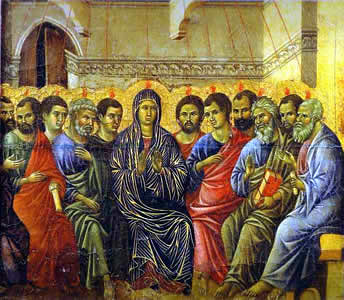 Why do Catholics and mainstream Protestant denominations celebrate the Feast of Pentecost, but not the other festivals listed in Leviticus 23 and Deuteronomy 16? Do we just "play favorites," simply ignoring or even rejecting Passover, Unleavened Bread, Trumpets, Atonement, and Tabernacles?
No. Keep in mind that we (at least Catholics) celebrate and meditate on key Christian events. We commemorate and rehearse things like the Annunciation; the Birth of Jesus; His Baptism; His Death, Burial, and Resurrection -- and the Descent of the Holy Spirit. We are obviously very Jesus-centered in our religion.
The Holy Spirit descended in a spectacular way on Pentecost. Not only did flames rest upon the heads of those who were waiting in obedience and praying with Mary, but the Spirit also lit a fire under their backsides, so to speak, and gave them power from on high to spread the gospel of Jesus and His kingdom to all nations in all the world. We celebrate, therefore, the gift of the Holy Spirit -- which is no small matter. There are innumerable lessons, teachings, and meditations to draw from Pentecost.
It is for the express Christian significance of Pentecost that we observe this day.
Israel's annual feasts
That's not to say the other Jewish festivals aren't "Christian" in a real sense. In these other holy days, there is a tremendous amount of symbolism that points us to Christ.
- Jesus is the "Lamb of God" not because of any physical resemblance, but because He, in the place of the Passover lamb, was our true sacrifice that truly forgives sin -- not in type or symbol, but in reality.
- St. Paul used imagery from the Feast of Unleavened Bread to illustrate the nature of sin (1 Corinthians 5:6-8).
- Trumpets were used, among other things, as calls to assembly and to announce war-making. As Christian soldiers, we can extract spiritual lessons from the Feast of Trumpets and recall that Jesus' return to earth and the resurrection of the saints will be announced with "trumpets."
- The Day of Atonement is fulfilled by Jesus who is our atonement. As the one Mediator and High Priest, He unites us with God.
- Just as Israel was to observe a festival that commemorated their living in temporary dwellings when they left Egypt, so we as Christians recognize that once we have left "Egypt" (sin), we are still sojourning in a land that is not our own. We are seeking a new country, a heavenly county, our "land of promise" -- "the city with foundations, whose architect and builder is God" (Hebrews 11:10).
Calling all men
With the coming of Christ, however, God is calling all men (not just the nation of Israel) to Himself. It all started with the man Abraham, then the clans that came from Abraham, then the nation of Israel. Finally, it culminated in Jesus, who, with His apostles, has shared God's revelation to all the earth. God is no longer dealing primarily with one nation among all nations; He is dealing with all peoples of the earth -- including those whose ancestors did not cross the Red Sea or inherit a land of promise!
The "universalization" of God's gift of salvation, as we see in the Acts 2 account of Pentecost, is why we observe that day. It is fundamental to Christianity. It marks the inauguration of the Church, the ethnically blind instrument God is using to reach His children. Once the Church reaches these children though the power of the Holy Spirit, they become part of the Church -- they become part of Jesus' Body. And perfect union with Jesus is our eternal destiny.
For the sake of argument, if Jesus had been conceived or born on Hanukkah -- the Festival of Lights -- then surely the Church today would be observing Hanukkah, pointing out that Jesus is the true Light of the world, the Light of life, and that we should let our Light shine before men to glorify the Father. It would be for these reasons that we would celebrate Hanukkuh -- not strictly because of the rededication of the Jewish temple, the commemoration of which being the day's original, primary focus.
As an interesting aside, apparently Jesus had no issue with an "extrabiblical" religious holiday such as Hanukkah, since He was walking about the temple on that day, speaking publicly (John 10:22-31). He did not speak against it, but rather spoke to the Jews about His miracles, which arguably could be connected to the fact that Hanukkah is associated with a miracle. ("The Temple in Jerusalem was purified, and the wicks of the Menorah miraculously burned for eight days with oil enough for only one day" -- Wikipedia.) Christian lessons could easily be expounded from this. But still, it is fundamentally "Jewish," even though it does carry spiritual lessons for all of us.
Keep your "Christian focus"
One unorthodox Christian publication recently began an article with these words:
Most professing Christians acknowledge just one of God's holy days -- Pentecost. . . . But what does it mean to them? To most, it is merely a celebration of the "birthday" of the church, or a time of changing the colors of their religious robes. But the real meaning goes deeper than this. Much deeper. Pentecost is rich with symbolism. Let's take a quick overview of this God-ordained day.The article then goes on to explain the very Christian significance of this day that you and I already understand, but the writer represents one of several movements that insist we as Christians should be observing all the Jewish festivals, and that we are sinning if we don't. Also, they condemn as pagan and sinful our celebration of clearly Christian days, such as Christmas and Easter, because they "hide" the plan of God.
But, in fact, the opposite is true: Christmas and Easter plainly reveal monumental Christian events that are absolutely crucial -- and as central as central can be -- to God's plan for man. Focusing exclusively on the holy days of Israel and rejecting Christian holy days can lead to many theological deficiencies which, potentially, can distort the Christian message.
Note, also, how these same preachers and writers characterize Catholics (and mainstream Protestants) as "professing Christians" (not true ones) who blindly follow empty traditions and are superficially concerned with wearing right-colored robes. But you should know better than that.
They would have you limit your observances to shadows and not the realities. They would have you be like the hungry dog who only sniffs and looks at his master's finger, oblivious to the fact that the finger is pointing to a bowl of fresh-mixed Gravy Train.
Be prepared. Learn your Faith. Read the Bible. Read the Catechism. If you have questions about challenges to the Faith, search for answers. Ask someone who can shed light on these challenges.
Don't fall prey to false teachers. Instead, fall down and pray -- that you may be made worthy of the promises of Christ. And praise God for sending us His Holy Spirit, who was given to the Church two thousand years ago on the day of Pentecost.
Thursday, May 24, 2007
Reading Pope's Book Scott-Free
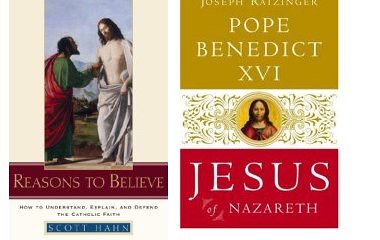
On the same day last week, I received both Scott Hahn's new book (Reasons to Believe) and Pope Benedict's new book (Jesus of Nazareth) in the mail.
It's not hard to imagine why I haven't been blogging much during the spare time that I have.
I tried to read Hahn's book first, or at least at the same time as the pope's, because his is a breezy, interesting, and easy-to-read style -- as well as insightful -- and anything by Pope Benedict seems a little daunting. I wanted to "warm up" to it.
But now I've put Scott's book aside. B16's is so rich, yet accessible. I don't generally like the overused term, but this pope's latest book is "spiritual food," and it really hits the spot. It's a nutritious alternative to the junk that's been coming out for years about the so-called "historical Jesus" (who barely resembles the Jesus of faith in any way). The book's forward and introduction alone are well worth the money. I'm looking forward to getting deeper into this great work.
Since Christians believe that everything revolves around the truth of Jesus, it is good to occasionally knock down the false "Jesuses" that are fabricated from the minds of pseudo-intellectual unbelievers.
No, not just knock them down. Knock them out of the park!
And this theologian extraordinaire-turned-pope is just the heavy hitter to do it.
Subscribe to:
Posts (Atom)