Thursday, February 14, 2008

Is God Bloodthirsty?

BobDobbs left a comment about my post, "Would You Wear an Electric Chair Necklace?"

This god despised you and all people so much that all he could do about it was torture his son and have him nailed to a cross. Sorry, he didn't actually kill the boy because legend has him coming back to life. But the Bible teaches that "it pleased God" to do this to his boy. Too bad there wasn't a volcano handy.

So your god commits heinous torture to satisfy his anger at you and you want to glorify it by wearing a cross?

Seek help. If I kill my son because my neighbor's dandelions are spreading onto my lawn I'm going to jail for a long, long time.

Why can't you people see the insanity of this bloodlust?

God is not insane or bloodthirsty. There are other, more sensible conclusions.

If God despises us, why would He sacrifice for us? Sacrifice is, by nature, an act of love. Otherwise the concept of sacrifice would make no sense. There is no other motivation. (Even sadism is a perverted form of self-love.)

Jesus' motivation, however, was the purest form of love. Despite the pain and a certain kind of natural fear, He willingly chose to give His life for us; He was not coerced by a sadistic "Father" God.

God did not inflict torture on His Son; rather, He allowed sinners to do this. That's what Scripture means by "it pleased God," which is not the most desirable translation for the Hebrew idiom. The RSV conveys it better with "Yet is was the will of the Lord to bruise him" (Isaiah 53:10).

You state that Jesus was not killed because "legend has him coming back to life." I don't understand your point, because this "legend" -- that is, a tremendous weight of oral and written tradition -- has Him both dying and being raised from the dead.

There's nothing heinous on God's part concerning His plan of salvation. Jesus chose to take the bullet for mankind's sins to demonstrate His love for us. He is determined to save all those who would be saved. His self-sacrifice shows the extent of His determination, for, as Scripture says, there is no love greater than this -- than to lay down one's life for his friends.

Wearing a cross or crucifix is a ready reminder of love, not a sick symbol of bloodlust.

Sunday, December 30, 2007

Kissing and Worship

A recent comment:
Yes, Darren, it's true Jeremiah 10 is referring to forming idols...so a fragrant evergreen decoration is no sin. But how do you justify all those idols that Catholics put everywhere? In their gardens, on their walls, their jewelry, statues of Mary and saints and crucifices galore? If they aren't objects of worship, why do they KISS them? Stop worshipping objects of wood and stone. Turn your worship upward to your Holy Father. (And I don't mean the Pope!)
Just like trees, paintings, cars, or people, statues are not "idols" unless they are worshiped.

I've been to many Masses, and "kissing" is not a common occurrence, except when the priest kisses the Holy Bible and the altar.

Even so, a kiss is not worship. A priest does not worship the Bible when he kisses it. Judas was not worshiping Jesus when he kissed Him. Members of the early Church did not worship Christians when they greeted each other with a "holy kiss."

I don't worship my wife when I kiss her. In-love teenage girls did not worship stationery when their handwritten letters were SWAK (Sealed With A Kiss). An old-fashioned gentleman doesn't worship a woman when he kisses her hand.

A kiss is a sign of reverence, respect, love -- but certainly not an unmistakable gesture of worship that is reserved for God alone!

Ask any Catholic if he or she worships an object of wood or stone, and the answer will be "Of course not!" Do you think the Catholic is mistaken?

What does it mean to "worship," anyway? Can a person accidentally worship something against his will? If he can "worship" something mistakenly or unknowingly by a mere external action (kissing a crucifix, decorating a Christmas tree, etc.), does that kind of "worship" have any meaning? It would be empty, which is hardly a trait of worship.

Real worship is adoration that arises from the heart and expressed in actions. It is paying homage to our Creator, recognizing God's supremacy in the universe and beyond. It is recognizing who and what He is, and submitting our will to His in love.

Viewing artwork as a reminder of God and of heroes of the Faith -- like an overseas military man looking at a photo of his wife or children -- does not constitute "worship." They are visual representations, reminders, of something else. The man who kisses the photo of his wife is not worshiping Kodak paper. Neither is he necessarily worshiping his wife.

Worship, by definition, cannot be mere lip service.

A reasonable person will therefore understand that Catholics do not worship objects of wood and stone.

Monday, December 24, 2007

"Church Is Cancelled -- It's Christmas!"

I'm wondering if the Catholic Church is the only place in these parts of Texas to go for Christian worship on Christmas Day.

I've heard from several non-Catholic friends who say they never have church on Christmas because their churches want you to spend time with family.

Why can't the family spend time at church? Don't we claim Christmas as a Christian holiday? I know that churches have services on Easter morning -- so what's the deal with Christmas? Or why not have a Christmas Eve service instead (if not in addition to)? And what of those people who don't have any family to share with?

Why not cancel services on Super Bowl Sunday so that football-loving families can spend some quality "down" time with each other?

I do understand that sometimes we don't "feel" like going to church. But we do it anyway on Sundays because we know it is part of the Christian life. Is Christmas not more special than an odinary Sunday? Why have a "religious" festival that is recognized, shared, and celebrated by the whole Church, but then not assemble as a church in commemoration of the birth of the God-Man?

We should welcome the Christmas celebration -- not sleep when He comes.

I know that sounded preachy. Sorry. But it's still something to consider.

Saturday, December 22, 2007

Unrelated: Jeremiah 10 and the Christmas Tree


Having grown up believing that Christmas is pagan and not to be observed by Christians, one classic scriptural misinterpretation I had was believing Jeremiah 10 condemned Christmas trees.

Read the passage for yourself here.

When I became of age and seriously began to "prove" my childhood faith to myself, I "proved" that God despised the practice of cutting down a tree from the forest, putting it on a stand, and decking it with gold and silver. Jeremiah described this so clearly, so explicitly -- how better could he have spelled out the plain truth about Christmas trees?

I later realized that my understanding of this passage was chiseled and fashioned by what my church had already taught me. I was already "suspicious" of Christmas, so I was quick to cling to conclusions when I saw such words (especially in the King James Version) as "tree," "axe," "deck," "gold," "silver," and "workman" (which I mistakenly understood to be synonymous with "lumberjack"). What else could this be except the modern Christmas tree? I thought. How could everyone be so blind?

Well, it took me a few more years myself to begin to see.

The chapter is properly understood when seen in its context of idolatry.

In this chapter, the Lord references "gods," "idols," and "images" (verses 11,14); in the KJV they are "gods," "graven image," and "molten image." Since when is there a commandment against using a tree as decoration? There is none. Why should God be angry with that? But He is sorely opposed to idolatry.

We see, therefore, that God opposes the practice of fashioning an image or statue (of any material) that is to be used as an idol -- an object of worship. Anything that takes the place of the true God -- whether a wooden idol, another person, or your own pride -- falls under the category of "idolatry," but in this context, God is specifically addressing the use of literal idols.

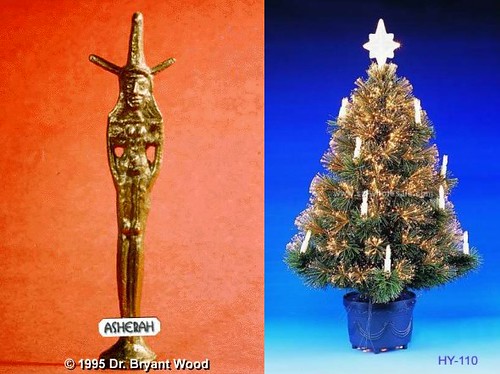
I have never known anyone to worship a Christmas tree. Now that I observe Christmas and have a decorative tree, I know with certainty that I do not worship it. It is not worshiped by those who view Christmas in the spiritual sense in which it's intended, and neither is it worshiped by those who see Christmas as a mere secular holiday as an excuse to party and accumulate material goods.

If a thing is not worshiped, and if it's not made by pagans to be an object of worship, it's not an idol. Is this not sensible?

Moreover, in verse 5 of Jeremiah 10, God mocks these idols by saying they are "upright as the palm tree, but speak not: they must needs be borne [i.e., carried], because they cannot go." In whose imagination might a Christmas tree appear to walk and talk? My artificial Christmas tree does not resemble anything that walks and talks; it resembles a blue spruce. It doesn't have a face, head, torso, arms, or legs. It's a bushy tree!

Was the tree of life in the Garden of Eden an idol? It had fruit that, if eaten, would provide eternal life. Who would label that tree an idol, or even a symbol of idolatry? No one. And no one assigns Christmas trees with the divine attributes of the tree of life of Genesis, so how can one conclude they are idols?

No matter how much someone wants to make it a sinister object of false worship, the Christmas tree is merely a decoration. If indoor decorative trees are an abomination, then let's ban the popular plastic ficus trees from Wal-Mart.

I don't question the sincerity of those Christians that are anti-tree and anti-Christmas, for I was one of them, and I know I was sincere. But I do know that my rejection of all things Christmas gave me a deficient understanding of the Incarnation, which is crucial and at the heart of Christianity. This all-important emphasis, I fear, is what anti-Christmas Christians are missing out on.

Instead, they're too busy cramming modern-day Christmas trees into the pages of the Old Testament.

Friday, December 14, 2007

The Rosary: Beads on a String, Not Genie in a Bottle


Does praying the Rosary guarantee instant "yes" answers to our supplications? Not at all.

God is not our Genie whose job is to grant all our wishes. If that's what He did, He would not be the God of love. As all parents know, to love a child is not to grant the child's every request; it is to provide for the child and do what is ultimately best for the child, who is often short-sighted and self-centered. Doing what's best may even mean allowing the child experience a kind of "suffering" now in order to achieve a positive result later. . . .

(See full post here.)