Wednesday, March 28, 2018

The Catholic Evangel (new blog)

This blog is dead, but it has been reborn at a new site with a new name - - at www.CatholicEvangel.com.

Check out out. Also like and share its Facebook page.

See you there! 

Monday, February 09, 2015

Sharpen Your Rosaries With Scripture


Praying the Rosary, as magnificent and sweet as it is, can be challenging to the new convert and seasoned Catholic alike. Common to both is one big difficulty: a lack of focus.

Normally, as we make our ring around the Rosary, we should be meditating on the individual scenes of the joyful, sorrowful, luminous, or glorious mysteries. We should rehearse them in our minds and ponder them in our hearts, blending them into our own spirits, so that “we may imitate what they contain and obtain what they promise.”

I was an adult convert to the Church, so when I first began praying the Rosary, it took a little while to memorize the vocal prayers and recite them all properly. I was so intent on “doing it right”saying the right words at the right time while navigating the beads—it felt that concentrating on the mysteries at the same time was nearly impossible.

But it was possible. After sufficient practice, I could go outdoors for a 30-minute nighttime stroll and think deeply on the mysteries while reciting the vocal prayers. Those were rich experiences: staring into the starry sky in the cool of the evening; lifting my heart to the Lord; finding a good pace with a peaceful rhythm in my breath, my fingers, and my thoughts.

Fast-forward a few years. These days, I can still struggle with focusing on the mysteries in prayer, but for different reasons. The vocal prayers are so ingrained in my muscle memory that the words just pour past my lips, and my fingers slide expertly over the beads, but my mind wanders from the mysteries. During the Hail Marys, my mind can go from updating my task list to planning my workout routine to thinking, “I really like blueberry pancakes!” Depending on the day, it can be a real fight to focus.

Nevertheless, I know I’m not alone when it comes to distraction. Don’t tell me you don’t occasionally have the same struggles. While some saints used to enter into mystical ecstasies while praying the Rosary, Saint Therese of Lisieux admitted in her autobiographical Story of a Soul,[B]ut when alone (I am ashamed to admit it) the recitation of the Rosary is more difficult for me than the wearing of an instrument of penance. I feel I have said this so poorly! I force myself in vain to meditate on the mysteries of the Rosary; I don’t succeed in fixing my mind on them.” Later she realized her efforts to focus were pleasing to our Mother.

In my own efforts to focus, one very helpful aid I’ve come across is the Scriptural Rosary. The Rosary is plenty “scriptural” on its own, but a “Scriptural Rosary” is one in which you read a verse of Scripture (relating to the present mystery) before each of the ten Hail Marys. The effect is that, as your mind begins to stray, each Bible verse that’s read before a Hail Mary gently draws you back to the mystery, sharpening your focus and coloring the mystery with God-breathed Scripture. It becomes the food to nourish your meditations.

My wife and I often pray this way together at home and in the car, but it’s also ideal for families with children, who are not always known for their laser-beam focus. Kids can take turns reading the Bible verses while the others say the vocal prayers.

Give it a try. You can buy Scriptural Rosary booklets from Catholic bookstores, or download one for free as a PDF or MP3. Follow along and see if it doesn’t help your meditations. You owe it to yourself and your family to once again take up this powerfully biblical prayer—but this time with your mind fixed and focused on each mystery of the Rosary, sharpened one verse at a time.

Friday, February 06, 2015

The Purpose of Life


Years ago I would listen to CRI's Bible Answer Man radio broadcast on the way home from work, and host Hank Hanegraaff would often say, "Christianity is so deep, you could drown in it; yet it is so simple, a child can understand it." I like his ability to distill profound truths into pithy proverbs.

That truth about Christianity resonates for me again after reading St. Teresa of Avila last night and Joseph Cardinal Ratzinger this morning. I like reading people with deep hearts and deep intellects so I can at least catch a glimpse of what they see and hopefully reduce it to language and concepts that I can understand, making it my own. They are good at seeing the complex and reducing it to words. I just hope to feed on the crumbs I'm able to catch from their table. I miss a lot.

But I do know the purpose of life is to be in right relationship with God, and the essence of that relationship is love. In love, God made us from nothing. Our response to that love, collectively and individually, has not been to reciprocate with all our love, but to have an inordinate love for ourselves and created things. And in love, He pursues us and picks us up, like a shepherd going down to free a wayward sheep that is hopelessly entangled in thickets. Only through His saving action can we be restored to right relationship with Him. We are not to be restored only to the original position of our first parents Adam and Eve, but to an even deeper and more perfect union with Him. Our "religion," therefore, is to rightly view the physical, natural world as good, but to view its Creator as better, and to respond accordingly—aligning our hearts and actions to this reality. Stripped to its simplest element, religion is rightly ordered love.

If we refuse this love, God will not coerce us. He's not a Cosmic Rapist. If we finish this life separated from God, in His kindness He will let us continue in the afterlife as we have chosen, forever reaping the same frustrating, miserable, painful effects of our disordered love. It's what we call hell.

On the other hand, if we die in a state of grace—that is, if we have even an imperfect love of God—He will allow that love to grow and reach its fullness, purifying us of anything that is not perfect love. Forevermore we will be able to see face to face the object of our love: the Lover of our souls, God our true Father. That's what we call heaven.

Old people: get ready. Sick people: beware. All other people: buckle up and look both ways before crossing the street, because you never know from one moment to the next when it will be your turn. Your duty, then, the only thing that makes sense, is to get real: to love God with all your mind, heart, and strength, and to love your neighbor as yourself. Really, it's so simple, a child can understand it.

Tuesday, February 03, 2015

Being Catholic Matters


“Catholic” is not just one among many acceptable religions, philosophies, or even Christian denominations. To think a person’s church or religious affiliation is unimportant, as long as he is generally “good,” is to overlook stark incompatibilities between the Catholic Church and other religions.

Consider Protestant and other non-Catholic Christians. While through their connection to Catholic Tradition, they have inherited sacramental baptism, possess the apostolic writings (the “New Testament”), and desire to follow our Lord, they have serious deficiencies and obstacles due to their imperfect union with the Church. There are real, practical consequences when one rejects the full deposit of Christian faith.

During Eucharistic adoration I often marvel, “Wow. Right now I am three feet away from my Creator. The one featured in the New Testament and foreshadowed in the Old, the one who preached the Sermon on the Mount, who healed lepers, who forgave the adulterous woman—who forgives me!—I’m looking at Him right here, right now! My Lord and my God!”

I assure my Baptist friends that I don’t worship Mary, despite the high regard in which we as Catholics hold her, even as we offer her our petitions in prayer. I’m careful to differentiate between reverence and worship. In fact, I point out, the Church explicitly condemns the adoration of any person or thing other than God. But I also say (to their shock) that when I’m at Eucharistic adoration, I fully worship the Blessed Sacrament before my eyes! That round, bread-like thing inside the monstrance is actually Jesus Himself!

Here’s the deal: If the Church is wrong about the Real Presence, then we are to be pitied for our primitive, unenlightened, stupid idolatry; we are guilty of worshiping the creation rather than the Creator. If, however, the Church has simply transmitted what Jesus taught her—that the Communion Host actually becomes His body, blood, soul, and divinity—then our Protestant brethren are missing out on a ton of life-giving graces that Jesus offers through the Mass.

Our beliefs have consequences, and we cannot afford to be indifferent toward them. Truth corresponds to reality; therefore, truth really matters.

There are other examples.

Due to sin and distraction and weakness, our prayers can be hindered. But we know that “the effectual fervent prayer of a righteous man avails much,” and we know we have recourse to Mary and the Saints—our family of “prayer warriors.” They will intercede for us. I know some of my prayers have been answered because of saints joining their prayers to mine. But, due to incorrect beliefs, Protestants generally don’t ask for saintly intercessions.

If we don’t believe in prayers for the dead, we’re not going to pray for our deceased loved ones. Consequently, if they are suffering in purgatory, our incorrect belief may delay their entrance into heaven.

Where certain Christian denominations reject baptismal regeneration—the belief that baptism actually restores new life—it’s not uncommon to postpone one’s baptism until his teens or twenties. That’s dangerous behavior based on wrong belief.

Rejection of the Church’s moral teachings (about marriage, contraception, homosexual unions, in vitro fertilization, self-abuse, etc.) leads to untold human suffering. It demonstrates the truth of Natural Law.

Examples could be multiplied all day long to illustrate the same point. The dogmas of our Catholic Church are not arbitrary. They are not her “best guesses.” They are not denominational flavors, subject to our spiritual palate’s taste.

No, she is tenacious about her teachings precisely because they are true—because they are the full deposit of faith entrusted to her by Jesus and the apostles.

So be sure to conform yourself daily in mind, body, and will to the teachings of Christ’s Church. By regularly cultivating a Catholic conscience, you will be equipped to share the unabridged gospel with confidence and conviction, with humility and genuine love toward others.

Being truly Catholic matters in real ways. It’s our sure salvation.

Thursday, January 15, 2015

I'll Confess . . . and So Should You

I've often found it difficult to go to a priest for the sacrament of Confession. Pride, shame, embarrassment, despair, repeat offenses—all these can be obstacles to confessing sins.

But understanding Confession makes it a lot easier, and can even make a person desire Confession. Like cleaning a wound, the temporary discomfort is worthwhile after experiencing the healing joy, peace, and confidence in knowing Jesus has forgiven you through the priest.

Yes, it is through the priest that Jesus Himself forgives.

Jesus shares the power to forgive
The origins of Confession are found in John 20:19–23:
On the evening of that day, the first day of the week, the doors being shut where the disciples were, for fear of the Jews, Jesus came and stood among them and said to them, “Peace be with you.” When he had said this, he showed them his hands and his side. Then the disciples were glad when they saw the Lord. Jesus said to them again, “Peace be with you. As the Father has sent me, even so I send you.” And when he had said this, he breathed on them, and said to them, “Receive the Holy Spirit. If you forgive the sins of any, they are forgiven; if you retain the sins of any, they are retained.”

It is significant that this was Jesus' first interaction with His hand-chosen disciples (the apostles) after His resurrection—on the very same day. If it seems to you like He was establishing a means to distribute the forgiveness He had just obtained for us through His death and resurrection, you're right. He was. It continues today through the successors of those very apostles—that is, our Catholic bishops, and priests who are authorized to assist them.

Forgiveness initiates healing
Strictly speaking, however, forgiveness is not the end goal. Don't think our sins simply need forgiveness in a forensic sense, a legal acquittal of guilt. This acquittal is absolutely necessary, but there's more to it. Our objective is to not merely be declared clean, but to be clean—to be healed.

This is why the Church does not label Confession as a Sacrament of "Forgiveness," but a Sacrament of Healing. Our sins not only break laws, they injure our souls and our relationship with others and God. Confession, then, is not a quick Band-Aid fix, but a visit to Dr. Jesus, our great Physician. With every trip to the confessional, we tell the priest our symptoms, our ailments, our sins, and Jesus forgives us immediately, but He also initiates a healing process of grace for our wounds. And He strengthens us against future temptations.

God is a Father who judges, not a Judge who fathers
God is not a TV courtroom judge looking to put the smackdown on us when we break rules. While it is His fatherly role to judge, we see God primarily as our loving and merciful Father who wants us to grow in our familial life with him. He knew we would still fail, and fail often, after our initial conversion to Him, so He gave us the sacrament of Confession—not to beat us up, but to lift us up. It's like pulling a child back onto his feet when he falls down learning how to walk.

Don't consider your confession a mere laundry list of transgressions, but ways in which your relationship with God (and others) has been ruptured.

We are not alone
When we sin, it affects not only us but others, even when it's not readily apparent to us. Similarly, when we repent and confess our sins, it's not just a private matter between you and the priest, but with Jesus and the entirety of the heavenly host. Be encouraged!

After His parable of the Lost Sheep, Jesus said, "Just so, I tell you, there will be more joy in heaven over one sinner who repents than over ninety-nine righteous persons who need no repentance" (Luke 15:7).

After the parable of the Lost Coin, Jesus said, "Just so, I tell you, there is joy before the angels of God over one sinner who repents" (verse 10).

In Jesus' parable of the Prodigal Son, after the son came home to confess his sins against his father, asking for mercy, the father shouts, "‘Bring quickly the best robe, and put it on him; and put a ring on his hand, and shoes on his feet; and bring the fatted calf and kill it, and let us eat and make merry; for this my son was dead, and is alive again; he was lost, and is found.’ And they began to make merry" (verses 22–24).

Just do it
We should not be afraid to confess our sins in the confessional with these things in mind. Moreover, the priest is bound by a seal under strict penalty never to divulge or even make use of anything he learns through your confession. So what happens in the confessional stays in the confessional.

Be not afraid. If you are Catholic, go to Confession and spill your guts so Jesus can heal your soul.

If you're not Catholic, what are you waiting for? Contact your local priest and inquire about how to enter, or be reconciled to, the Church. Jesus obtained forgiveness for you, personally, 2000 years ago as we reckon time; you just have to knock on His door and pick it up. Our Lord is waiting for you.

Why I Don't Like Bible "Verses"

I grew up reading the old King James Version of the Bible. I've had many of them. At 41 years old, I still have one of my earliest Bibles from when I was in the first grade. The rich leather scent of its imitation-leather cover fills my head with memories of my early encounters with Holy Writ.

But it wasn't until I started reading the New King James Version (NKJV) in my early 20s that I enjoyed reading the Bible. Before that, I "studied" mostly in that I looked up Bible verses that were referenced in sermons or in literature in order to "prove" whether they said what the preacher or article said they said. I had certain key references I remembered, wrote down, and marked in my Bible to support the beliefs I had. But I didn't always just sit down and read large portions of Scripture straight through.

Here is my theory as to why, and I think it may apply to many others without their realizing it: The way the traditional KJV text is laid out, a line break is inserted after each verse, so that each verse begins a new line of text. (The same can be said of the Douay-Rheims Catholic Bible.)


This, combined with a culture of prooftexting by many Protestants and "Bible Christians," led me to view the Bible as a collection of "verses." I was actually taught by leaders in my church (before I was Catholic) that the Bible was like a giant jigsaw puzzle, that you have to assemble all the scattered verses together on a specific topic to understand the "truth." A little here and a little there, you know. Consequently, topical studies were commonplace.


In religious discussions or debates, it seemed people in my tradition ended up slinging Bible verses at their opponents, and they were met by return fire, so that it was raining fiery Scripture verses—and whoever launched the most and best verses came out the victor. That may be an exaggeration, but not by much.

At one point, I read an enlightening book by Gordon Fee and Douglas Stuart entitled "How to Read the Bible for All Its Worth" (as a Catholic, I disagree with certain of the writers' interpretations, but at the time, the book helped me tremendously to appreciate the art and science of biblical interpretation).

Alongside that book, reading the NKJV (and later, other versions, such as the NIV, RSV, and NAB) helped me to understand that most of Scripture is not a collection of phrases or "verses" to be culled out; rather, it is composed of individual books that follow a train of thought. That's why editors of modern translations group the text into logical paragraphs.


DSC_0078

To me, reading paragraphed text makes it less tempting to engage in prooftexting—that is, to pick out a verse (usually out of context) to "prove" a particular interpretation of Scripture. Instead, it makes it easier to see a statement within its broader context within a paragraph, which can be understood within the context of surrounding paragraphs. When considering a verse within the writer's flow of logic, understanding comes much easier. That's why I prefer studying and reading entire books of the Bible rather than culling together scattered verses from all over to make them fit the picture you think the jigsaw puzzle reveals—because, with exceptions such as the Book of Proverbs, the individual books were written with a logical progression of thoughts, in linear fashion—not as a series of standalone verses. We should read them as they were intended to be read.

Otherwise, you get silly interpretations such as this (which I once held):


To help avoid a prooftexter's mentality, there are many who prefer single-column Bibles (shown above) rather than the more traditional two-column layouts. Right now, I still like two columns for easier reading, but I don't think I am stuck on that opinion. I can understand the attraction to single-column text. After all, nearly all other books we read are shown in a single column of text.

Is the Rosary a "Vain Repetition"?


“God is not interested in chants, endlessly repeated phrases, or the superstitious fingering of beads,” writes Fred Coulter, president of the Christian Biblical Church of God, in his book Lord, What Should I Do? Having already mentioned the Rosary, he continues, “Such methods are mechanical and have nothing to do with true biblical prayer. In fact, ritual prayers are evidence that we are just too busy to really pray from our hearts.


“The truth is that God does not want us to pray in any of these ways.” (p. 84).


To support his assertions, Coulter then quotes Jesus who says, “And when you pray, do not use vain repetitions, as the heathen do; for they think that by multiplying their words they shall be heard. Now then, do not be like them; for your Father knows what things you have need of before you ask Him” (Matthew 6:5–8).

Coulter continues by recounting the prophets of Baal (1 Kings 18), who “called on the name of Baal from morning even until noon, saying, ‘O Baal, hear us.’ But there was no voice, nor any who answered” (verse 26).

“This account...,” says Coulter, shows that “we need not pray like the heathen” (p. 86).

Is it reasonable to liken Christian prayers, such as a 15-minute Rosary, to the prayers of the prophets of Baal? Should Catholics worry that it is wrong to pray the Rosary—or any other prayer that is repeated or involves repetition?

Absolutely not—not if you’re a Bible-believing Catholic. Coulter understands neither the Rosary nor Scripture.

First, let’s start by agreeing that everything Jesus says is true. There is never, ever a reason to argue with Him. He is Truth itself. But then let’s see whether Coulter is in fact “believing His Bible” or imposing a popular Protestant spin on the words of our Lord.

Back to what Jesus actually said. Does He condemn the prayer of repetition? By no means. Rather, He condemns “vain repetition.”

Consider Jesus’ own example. He prayed in the garden that “this cup pass from me” (Matthew 26:39). He prayed it a second time. Then He “prayed a third time, saying the same words” (verse 44). Not just the same intention, but the “same words.”

The Lord also accepts worship from heavenly creatures—whom Coulter agrees are sinless—as they “rest not day and night, saying, Holy, holy, holy, Lord God Almighty, which was, and is, and is to come” (Revelation 4:8). Reciting the Rosary is definitely less repetitive than the prayer of angels.

Coulter says the “keys for truly sincere prayer that God will hear and answer are contained in the Bible, not in the precepts, superstitions, traditions or inventions of men” (p. 84). And, though he makes disparaging reference to “pre-written prayers,” he also says to “[u]tilize the book of Psalms in your prayers, as many of them are actually prayers. Read them aloud to God, adding your own thoughts or comments” (p. 92). Good. Catholics do that every day. I wonder: Does Coulter ever pray Psalm 136?

Read it aloud to hear its repetitiveness. In it, the phrase “for his mercy endureth for ever” is repeated 26 times in each of its 26 short verses!

The truth is that, in itself, nothing is wrong with repetition. It can serve to emphasize a prayerful thought, or to express that which is beyond the grasp to find other adequate forms of expression.

The Catholic Church, however, always faithful to our Lord’s teaching, does warn against “vain repetition,” even with regard to the Rosary. Listen to Pope John Paul II in his 2002 encyclical on the Rosary as he quotes Pope Paul VI:

Without contemplation, the Rosary is a body without a soul, and its recitation runs the risk of becoming a mechanical repetition of formulas, in violation of the admonition of Christ: ‘In praying do not heap up empty phrases as the Gentiles do; for they think they will be heard for their many words’ (Mt 6:7). By its nature the recitation of the Rosary calls for a quiet rhythm and a lingering pace, helping the individual to meditate on the mysteries of the Lord’s life as seen through the eyes of her who was closest to the Lord. In this way the unfathomable riches of these mysteries are disclosed.
Properly prayed, the Rosary encourages the pray-er to meditate on the various scenes and truths of the gospel, while simultaneously voicing the prayer Jesus taught us (the "Our Father," or "Lord's Prayer"—Matthew 6:9–15) and the words of Elizabeth and the angel Gabriel to Mary, the mother of Jesus (included in the "Hail Mary"—Luke 1:28,42). Just as Mary encountered the great mysteries of the gospel and "kept all these things, pondering them in her heart" (Luke 2:19; cf. 1:29; 2:51), so do we contemplate the mysteries of Christ alongside her.

Rather than a prayer that shows we "are just too busy to really pray from our hearts," it is a prayer designed to pray from our hearts. It's a meditation on the gospel.


So never let so-called “Bible Christians” cast doubt on Catholic teachings or approved devotions, because, after 2000 years, the Catholic Church has never ceased being the preeminent “Bible Church”: the Church that Jesus built.


(To learn how to pray the Rosary, download this one-page PDF from Rosary Army).

Monday, January 12, 2015

Come Home


I want everyone, even you, to be Catholic.

It doesn't matter whether you have same-sex attraction, whether you aborted your baby or someone else's, whether you're a non-Catholic Christian, a Jehovah's Witness or Mormon, an anti-Catholic, an agnostic, an atheist, or just an all-around jerk—as long as you are human, you bear God's image, and I want you to be Catholic. Jesus loves you, and He wants you to be Catholic, too, because 2000 years ago He built His Church so that you could be a part of His Body. It is through His Church that you encounter Jesus up close and personal, allowing you to have a true relationship with your Savior and Father in heaven through the Holy Spirit.

If you were baptized in any Christian denomination, you are already connected to the Church of Jesus, but unless you are Catholic, you are not yet fully reconciled with the Church—and you are missing out.

Come home, and see the Lord—body, blood, soul, and divinity—in the sacrament of the Eucharist.

Come home, and hear the voice of Jesus absolving you of your sins—no matter how bad they are, no matter how often you've committed them, no matter how broken you feel—in the sacrament of Reconciliation (Confession).

Come home, and don't think you have to reinvent the wheel of Christian theology. Just as the Church made an authoritative judgment in her Jerusalem Council (Acts 15) about whether Gentiles need to be circumcised and keep the Law of Moses, so she has continued to proclaim the truth of Christianity to this day. And truth does not change. The Catholic Church does not restore truth; she preserves it. And you can count on it.

If you are not a practicing Catholic, check out the Catholics Come Home Web site and see what you've been missing. Read some conversion stories. Listen to or view EWTN on TV or online. If you are already Christian, be sure to explore Scott Hahn's excellent biblical studies and presentations at www.salvationhistory.com. And if you need to be argued into the Faith, that's fine—visit Catholic Answers.

The most valuable advice I can give is to obtain a copy of the Catechism of the Catholic Church. If you just can't wait (or can't afford it), you can read a searchable version online.

I'm a convert myself, and on this blog I will post my personal comments - - Catholic comments - -  as I navigate our darkened world by the light of Jesus. 


Is Masturbation a "Gift of God"?

Over the years, I've read and enjoyed a couple of old books by Christian writer and preacher, Charlie Shedd (namely, Letters to Philip and Letters to Karen), but I am very disappointed with one I've come across here at the house entitled The Stork Is Dead, written in 1968 for teenagers about sex. Mrs. Billy Graham wrote a blurb for it, saying, "Thank God for a book that tells it like it is about sex as God meant it to be."

Yet in the book he has a chapter called "Masturbation - - Gift of God," in which he explains how to evaluate whether your fantasies are okay, how masturbation "can be an important part, a very personal, strengthening part of your self-identity," that "teenage masturbation is preferable to teenage Intercourse," that "you will need some release," that "masturbation is a gift of God," that you should "thank God for it and use it as a blessing."

This unenlightened, dangerous, and sinful advice quite naturally leads to his next chapter, "Doing Wrong the Right Way," in which he advises teens who choose to fornicate with each other to "go somewhere. And the place I recommend is right down to the drugstore. For safety's sake, go together! I believe in double protection for unmarried teenagers. That means you both use something." He includes a thank-you letter from just such a young unmarried couple who took his advice.

I understand well, as we all do, how difficult it can be to remain pure in our over-sexualized culture. But the illuminating truth about sexuality needs to be taught, exemplified, and respected. Christians do us no favors by compromising. Acceptance of masturbation leads to all kinds of further confusion, misunderstandings, and deviancy - - and heartache, broken spirits, and broken homes.

The truth is that the sexual act belongs in the exclusive context of marriage between a man and a woman, who are responsible for caring for any children that may spring forth from their union. The act serves to both unite the married couple and say yes to the possibility of new life. It's for bonding and babies, love and life. If this natural purpose is frustrated or severed by masturbation, fantasies and fetishes, pornography, prostitution, fornication, artificial contraception, abortion, hooking up, fellatio for its own sake, homosexual or polygamous "marriage," pedophilia, bestiality, incest, etc., or any other such perversion of what is clearly natural and intended by God according to how our bodies and souls have been made, then trouble will ensue for us individually and for our culture.

Just as an automobile needs to be operated according to its nature in order to work properly, so it is with our own selves, as composite beings of body and soul. We have to operate according to our design or we will crash and burn.

This is not to say that we have no hope if we are guilty of some or all of these sins. Our Lord Jesus is faithful to forgive our sins and save us from them if we will just repent and confess them. Not only will He forgive us and thereby declare us clean, He will - - if we let Him - - give us the grace we need to actually be clean. It is never too late on this side of the grave to start living the pure life required of us. And any purity we obtain is credited to His work.

There is plenty of other junk in the Charlie Shedd book. As we sort through all the excess books in our possession, this one will skip the Goodwill box and go straight to the trash bin, where trash belongs.

Sunday, June 01, 2008

Karl Keating vs. Peter Ruckman

On YouTube today, I found this debate between well-known Catholic apologist Karl Keating, of Catholic Answers, and Peter Ruckman, of the Bible Baptist Bookstore.

Each segment is over two hours long. I'm only an hour into the first one right now. My first impression is that it's way too disorganized. The lack of direction is disappointing. I don't think that's fair to the listener, who deserves debaters who are prepared for and dedicated to a more specific topic. Nevertheless, they address interesting and poignant issues.

Peter Ruckman has a lot of charisma and is a more entertaining speaker, replete with zingers and cute digs. Karl Keating, not as polished or as good on his feet as his counterpart, is, in my opinion, much more reasonable and intellectually honest, able to address issues directly without cheap shots. He did a good job considering he's not the best public speaker, is on the defense, and is in the midst of a "hostile" audience. Give it a listen if you have the time and inclination. Note that the video is of poor quality.

I just can't believe Karl Keating never had any hair. This video is from the 1980s. It's like Doctor Emmit Brown of the Back to the Future movies -- there was never a time when he had hair.


PS: The book Karl Keating wrote is a masterpiece: Catholicism and Fundamentalism -- The Attack on "Romanism" by "Bible Christians." It was very helpful to me when I first began my journey toward the Catholic Church.

Sunday, April 27, 2008

An Early Witness Puts 'Soul Sleep' to Rest

Just as Jehovah's Witnesses believe, I grew up believing that when a person dies, he or she remains in an unconscious state until the resurrection of the dead. I believed our souls could not survive the body. I believed this to be the biblical understanding, and that Christians believed this until pagan philosophy infiltrated the Church, certainly by A.D. 325 at the Nicene Council.

The orthodox Christian understanding (which I now hold) is that the soul indeed survives the body and awaits the resurrection, in which our souls are reunited with our resurrected, glorified bodies.

This morning, I was re-reading St. Clement's epistle to the Romans, and I came across a passage that struck a chord with me several years ago. Clement, who lived from A.D. 30–100, is likely the associate of the apostle Paul (see Philippians 4:3). He was the fourth bishop of Rome, following Peter, Linus, and Cletus.

His letter is quite early, dated at A.D. 97 at the latest—way before the "evil" influences of the emperor Constantine. The letter possibly could have been written while the apostle John was alive. Here is a passage I want to share with you:
But not to dwell upon ancient examples, let us come to the most recent spiritual heroes. Let us take the noble examples furnished in our own generation. Through envy and jealousy, the greatest and most righteous pillars [of the Church] have been persecuted and put to death. Let us set before our eyes the illustrious apostles. Peter, through unrighteous envy, endured not one or two, but numerous labours and when he had at length suffered martyrdom, departed to the place of glory due to him. Owing to envy, Paul also obtained the reward of patient endurance, after being seven times thrown into captivity, compelled to flee, and stoned. After preaching both in the east and west, he gained the illustrious reputation due to his faith, having taught righteousness to the whole world, and come to the extreme limit of the west, and suffered martyrdom under the prefects. Thus was he removed from the world, and went into the holy place, having proved himself a striking example of patience.
Clement describes the apostles as being in his "own generation," and upon their deaths, Peter and Paul (1) "departed to the place of glory" and (2) "went into the holy place." These would be strange descriptions if he believed in soul sleep. Neither did he act like he was introducing a new doctrine. He wasn't even attempting to explain the state of the soul at death. He merely wrote of martyrdom and spiritual heroes.
No longer must I contrive excuses for St. Paul, for example, when he speaks of being "absent from the body" and "at home with the Lord" (2 Corinthians 5:8). The natural meaning of his words are perfectly reasonable when I consider the beliefs of the early church—even those who personally knew the apostle. If this is the same Clement that is mentioned in Scripture, Paul called him a fellow laborer whose name was written in the book of life.

One thing that my Jehovah's Witness friends—and I myself, years ago—misunderstood is that Catholics do not believe that our reward is merely "when you die, you go to heaven." Instead, Catholics teach that our ultimate reward will involve the bodily resurrection, when our souls are reunited with our bodies.

The dispute boils down to whether the soul exists consciously during the interim. While that is the dispute, it was not a dispute during the time of the apostles and in the first generations of the Church. It was taken for granted.

Saturday, March 29, 2008

Catholicism and the Search for Truth


I was told yesterday that I was "not a Catholic at heart." The reason? I believe in a "personal relationship" with Jesus.

The non-denominational Christian woman who told me this is baffled that I could turn to Catholicism. She passionately explained the importance of living righteously, of letting the blood of Jesus cover me, of putting all my trust in Him. Christianity is not about academic understanding, but about walking with the Lord.

I could not argue with her impassioned plea.

Over the last few weeks, I have been targeted by a Jehovah's Witness, who, last weekend, brought an ex-Catholic JW to help pry me from Rome's grip. She and her literature said we must search earnestly, humbly, and with a teachable spirit before Jehovah reveals to us "the Truth." There is only one Truth, one religion. Differing, competing religions cannot all be true. We must reject man-made traditions that would replace the Word of God.

I could not argue with her logic.

Yet, neither of these women will accept that their understanding of Catholicism is misguided, for Jesus is the Truth at the center of Catholicism. He is the only path to salvation. God alone is to be worshiped. Holy Scripture is practically the air we breathe at Mass.

Instead, these gentlepersons (whom I respect) insist on portraying a hackneyed caricature of Catholicism: Catholics worship idols. Catholics worship Mary and the Saints. Catholics can go sin as long as they go to Confession. Catholics ignore Jesus. Catholics don't believe in the Holy Spirit. Catholics believe they can earn their way to Heaven. Catholics aren't "born again." Catholics don't "go by the Bible." Catholics worship the Pope. Catholics think the Pope can do no wrong.

These characterizations can agitate me, yet I'm patient because I once believed the same things about Catholics. Perhaps my patience is sometimes misunderstood as "coming around" to anti-Catholic schools of thought. Instead, I see this patience as a virtue; there's no sense in constantly whacking non-Catholics over the head with Catholic insights in every discussion. (That's what this blog is for!)

I was drawn to Catholicism because I was open to "truth," because I wanted to reject man-made traditions that conflict with the Word of God, because I believed in Scripture, because I believed in a "personal relationship" with Jesus.

Had I not investigated authentic Catholic teaching with these principles in mind, I would have remained ignorant as a non-Catholic. Too many people automatically reject Catholicism because they think they understand it, but don't.

Don't believe disgruntled ex-Catholics, don't believe priests or bishops in schism with the Church, don't believe Jack Chick comic books, don't believe convincing Protestant pastors -- read the Catechism of the Catholic Church. Read the Church Fathers. Talk to well-grounded members of the clergy. Listen to faithful Catholics. Go to primary sources of information.

If there's something that troubles you, don't assume Catholicism is automatically wrong. Ask for clarification. Debate Catholicism with an open mind. Seek answers. Feel free to walk away if you have searched for answers and are convinced they are wrong, but don't fall into the trap of misrepresenting the Church's teachings, and hating the Church based on misunderstandings.

Bishop Fulton Sheen's words are indeed true:
There are not over a hundred people in the U.S. that hate the Catholic Church. There are millions, however, who hate what they wrongly believe to be the Catholic Church—which is, of course, quite a different thing.

Sunday, March 16, 2008

"Anything Goes" in the Marriage Bed?

It is said by a number of individual Christians that "the marriage bed is undefiled," and by that they mean "anything goes" in the bedroom as long as you're married.

This has been said to justify sodomy, artificial contraception, sadomasochism, wild role playing, and any number of perversions of the marital act.

The scripture these people reference is often misunderstood because of the awkward wording of the King James Version (according to today's English style):
Marriage is honourable in all, and the bed undefiled: but whoremongers and adulterers God will judge (Hebrews 13:4).
Read from a certain perspective, this can seem to say all things are acceptable in the marriage bed.

But read it again in another translation, such as the New American Standard Bible:
Marriage is to be held in honor among all, and the marriage bed is to be undefiled; for fornicators and adulterers God will judge.
Go back to the KJV's rendering, and you can understand it in a new light. It's contrasting a wholesome marriage and its undefiled bed with whoremongering and adultery. Bring those things into the bed, and that bed is now defiled.
This scripture has to do with marital chastity. It does not intend to say that all degenerate or selfish imaginations are okay as long as you're married.

Thursday, February 14, 2008

Is God Bloodthirsty?

BobDobbs left a comment about my post, "Would You Wear an Electric Chair Necklace?"

This god despised you and all people so much that all he could do about it was torture his son and have him nailed to a cross. Sorry, he didn't actually kill the boy because legend has him coming back to life. But the Bible teaches that "it pleased God" to do this to his boy. Too bad there wasn't a volcano handy.

So your god commits heinous torture to satisfy his anger at you and you want to glorify it by wearing a cross?

Seek help. If I kill my son because my neighbor's dandelions are spreading onto my lawn I'm going to jail for a long, long time.

Why can't you people see the insanity of this bloodlust?
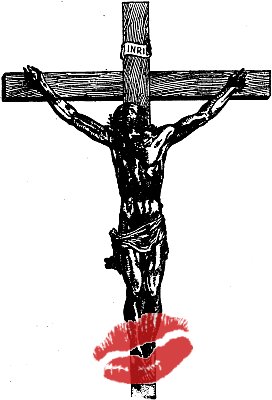
God is not insane or bloodthirsty. There are other, more sensible conclusions.

If God despises us, why would He sacrifice for us? Sacrifice is, by nature, an act of love. Otherwise the concept of sacrifice would make no sense. There is no other motivation. (Even sadism is a perverted form of self-love.)

Jesus' motivation, however, was the purest form of love. Despite the pain and a certain kind of natural fear, He willingly chose to give His life for us; He was not coerced by a sadistic "Father" God.

God did not inflict torture on His Son; rather, He allowed sinners to do this. That's what Scripture means by "it pleased God," which is not the most desirable translation for the Hebrew idiom. The RSV conveys it better with "Yet is was the will of the Lord to bruise him" (Isaiah 53:10).

You state that Jesus was not killed because "legend has him coming back to life." I don't understand your point, because this "legend" -- that is, a tremendous weight of oral and written tradition -- has Him both dying and being raised from the dead.

There's nothing heinous on God's part concerning His plan of salvation. Jesus chose to take the bullet for mankind's sins to demonstrate His love for us. He is determined to save all those who would be saved. His self-sacrifice shows the extent of His determination, for, as Scripture says, there is no love greater than this -- than to lay down one's life for his friends.

Wearing a cross or crucifix is a ready reminder of love, not a sick symbol of bloodlust.

Sunday, December 30, 2007

Kissing and Worship

A recent comment:
Yes, Darren, it's true Jeremiah 10 is referring to forming idols...so a fragrant evergreen decoration is no sin. But how do you justify all those idols that Catholics put everywhere? In their gardens, on their walls, their jewelry, statues of Mary and saints and crucifices galore? If they aren't objects of worship, why do they KISS them? Stop worshipping objects of wood and stone. Turn your worship upward to your Holy Father. (And I don't mean the Pope!)
Just like trees, paintings, cars, or people, statues are not "idols" unless they are worshiped.
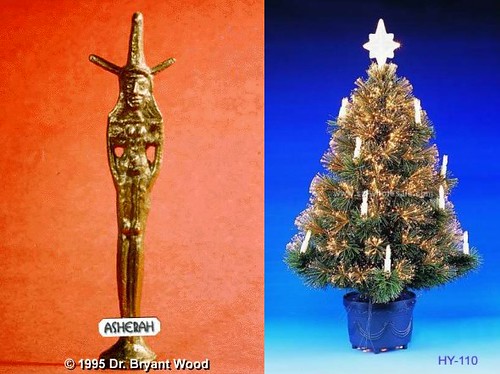
I've been to many Masses, and "kissing" is not a common occurrence, except when the priest kisses the Holy Bible and the altar.

Even so, a kiss is not worship. A priest does not worship the Bible when he kisses it. Judas was not worshiping Jesus when he kissed Him. Members of the early Church did not worship Christians when they greeted each other with a "holy kiss."

I don't worship my wife when I kiss her. In-love teenage girls did not worship stationery when their handwritten letters were SWAK (Sealed With A Kiss). An old-fashioned gentleman doesn't worship a woman when he kisses her hand.

A kiss is a sign of reverence, respect, love -- but certainly not an unmistakable gesture of worship that is reserved for God alone!

Ask any Catholic if he or she worships an object of wood or stone, and the answer will be "Of course not!" Do you think the Catholic is mistaken?

What does it mean to "worship," anyway? Can a person accidentally worship something against his will? If he can "worship" something mistakenly or unknowingly by a mere external action (kissing a crucifix, decorating a Christmas tree, etc.), does that kind of "worship" have any meaning? It would be empty, which is hardly a trait of worship.

Real worship is adoration that arises from the heart and expressed in actions. It is paying homage to our Creator, recognizing God's supremacy in the universe and beyond. It is recognizing who and what He is, and submitting our will to His in love.

Viewing artwork as a reminder of God and of heroes of the Faith -- like an overseas military man looking at a photo of his wife or children -- does not constitute "worship." They are visual representations, reminders, of something else. The man who kisses the photo of his wife is not worshiping Kodak paper. Neither is he necessarily worshiping his wife.

Worship, by definition, cannot be mere lip service.

A reasonable person will therefore understand that Catholics do not worship objects of wood and stone.

Monday, December 24, 2007

"Church Is Cancelled -- It's Christmas!"

I'm wondering if the Catholic Church is the only place in these parts of Texas to go for Christian worship on Christmas Day.

I've heard from several non-Catholic friends who say they never have church on Christmas because their churches want you to spend time with family.

Why can't the family spend time at church? Don't we claim Christmas as a Christian holiday? I know that churches have services on Easter morning -- so what's the deal with Christmas? Or why not have a Christmas Eve service instead (if not in addition to)? And what of those people who don't have any family to share with?

Why not cancel services on Super Bowl Sunday so that football-loving families can spend some quality "down" time with each other?

I do understand that sometimes we don't "feel" like going to church. But we do it anyway on Sundays because we know it is part of the Christian life. Is Christmas not more special than an odinary Sunday? Why have a "religious" festival that is recognized, shared, and celebrated by the whole Church, but then not assemble as a church in commemoration of the birth of the God-Man?

We should welcome the Christmas celebration -- not sleep when He comes.

I know that sounded preachy. Sorry. But it's still something to consider.

Saturday, December 22, 2007

Unrelated: Jeremiah 10 and the Christmas Tree


Having grown up believing that Christmas is pagan and not to be observed by Christians, one classic scriptural misinterpretation I had was believing Jeremiah 10 condemned Christmas trees.

Read the passage for yourself here.

When I became of age and seriously began to "prove" my childhood faith to myself, I "proved" that God despised the practice of cutting down a tree from the forest, putting it on a stand, and decking it with gold and silver. Jeremiah described this so clearly, so explicitly -- how better could he have spelled out the plain truth about Christmas trees?

I later realized that my understanding of this passage was chiseled and fashioned by what my church had already taught me. I was already "suspicious" of Christmas, so I was quick to cling to conclusions when I saw such words (especially in the King James Version) as "tree," "axe," "deck," "gold," "silver," and "workman" (which I mistakenly understood to be synonymous with "lumberjack"). What else could this be except the modern Christmas tree? I thought. How could everyone be so blind?

Well, it took me a few more years myself to begin to see.

The chapter is properly understood when seen in its context of idolatry.

In this chapter, the Lord references "gods," "idols," and "images" (verses 11,14); in the KJV they are "gods," "graven image," and "molten image." Since when is there a commandment against using a tree as decoration? There is none. Why should God be angry with that? But He is sorely opposed to idolatry.

We see, therefore, that God opposes the practice of fashioning an image or statue (of any material) that is to be used as an idol -- an object of worship. Anything that takes the place of the true God -- whether a wooden idol, another person, or your own pride -- falls under the category of "idolatry," but in this context, God is specifically addressing the use of literal idols.

I have never known anyone to worship a Christmas tree. Now that I observe Christmas and have a decorative tree, I know with certainty that I do not worship it. It is not worshiped by those who view Christmas in the spiritual sense in which it's intended, and neither is it worshiped by those who see Christmas as a mere secular holiday as an excuse to party and accumulate material goods.

If a thing is not worshiped, and if it's not made by pagans to be an object of worship, it's not an idol. Is this not sensible?

Moreover, in verse 5 of Jeremiah 10, God mocks these idols by saying they are "upright as the palm tree, but speak not: they must needs be borne [i.e., carried], because they cannot go." In whose imagination might a Christmas tree appear to walk and talk? My artificial Christmas tree does not resemble anything that walks and talks; it resembles a blue spruce. It doesn't have a face, head, torso, arms, or legs. It's a bushy tree!

Was the tree of life in the Garden of Eden an idol? It had fruit that, if eaten, would provide eternal life. Who would label that tree an idol, or even a symbol of idolatry? No one. And no one assigns Christmas trees with the divine attributes of the tree of life of Genesis, so how can one conclude they are idols?

No matter how much someone wants to make it a sinister object of false worship, the Christmas tree is merely a decoration. If indoor decorative trees are an abomination, then let's ban the popular plastic ficus trees from Wal-Mart.

I don't question the sincerity of those Christians that are anti-tree and anti-Christmas, for I was one of them, and I know I was sincere. But I do know that my rejection of all things Christmas gave me a deficient understanding of the Incarnation, which is crucial and at the heart of Christianity. This all-important emphasis, I fear, is what anti-Christmas Christians are missing out on.

Instead, they're too busy cramming modern-day Christmas trees into the pages of the Old Testament.

Friday, December 14, 2007

The Rosary: Beads on a String, Not Genie in a Bottle


Does praying the Rosary guarantee instant "yes" answers to our supplications? Not at all.

God is not our Genie whose job is to grant all our wishes. If that's what He did, He would not be the God of love. As all parents know, to love a child is not to grant the child's every request; it is to provide for the child and do what is ultimately best for the child, who is often short-sighted and self-centered. Doing what's best may even mean allowing the child experience a kind of "suffering" now in order to achieve a positive result later. . . .

(See full post here.)

Sunday, December 09, 2007

The Rosary Reader (Blog)


I just began a new blog. Add a comment to let me know what you think. Thanks.

The Rosary Reader

Saturday, December 01, 2007

Christmas Really Does Honor Christ!


As Advent season arrives again, so does the annual explosion of anti-Christmas rhetoric. As if we don't get enough of it from atheists, some of it is published by various Christian sects who sincerely intend to restore the true Faith -- the Faith that was "once delivered to the saints," without extra, man-made garbage to pollute the clear water of the Word. Unfortunately, their pure intentions can lead to absurd conclusions, such as: Christmas is pagan.

One article that caught my attention this year is entitled "Does Christmas Really Honor Christ?" I truly mean no disrespect to the author (for I once held his views), but the more I read such articles, the more juvenile I perceive "Christian" arguments against Christmas to be.

Among them are:
  • We don't know Jesus' actual date of birth, so we're not honoring Him by observing December 25, which is a date pagans used to honor their own "gods."
  • We're not worshiping Jesus in "truth" because certain aspects of some traditional nativity scenes are factually incorrect (e.g., the wise men appearing at the manger instead of at the house in which the holy family later lived).
  • Santa Claus is a lie.
  • Many people suffer depression during the holidays.
  • Illicit use of alcohol and sex occur during the holidays.
  • Unlike the wise men, we give gifts to each other rather than to Jesus.
  • Birthday celebrations are pagan, even the Lord's.
  • The Puritans opposed Christmas.
  • Neither Jesus nor His apostles taught others to celebrate his birthday.
I'm not opposed to addressing these and similar issues, since I had to deal with them before, but a more troubling accusation deserves attention here.

Did Jesus ever grow up?
From the aforementioned article:
Even more serious, however, is the false impression given by Christmas that Christ is simply a helpless baby. A little girl viewing a nativity scene was heard to ask her mother: "Did Jesus ever grow up?" Why did she ask? "Well," she responded, "he hasn't grown at all since I saw him last year!" And the impression left at Christmas is just that, that Christ was a helpless babe, not the ruling King that He is, one who will soon rid the earth of all unrighteousness (Psalm 2:9,12; 110:1,2; Revelation 12:5; 19:15,16).
In his zeal to promote the pure gospel, the author not only insults the intelligence of his adult readers, but minimizes the essential truth of Jesus' birth!

First, Christmas does not limit our view of Jesus as a sweet little baby at the exclusion of all else, just as Good Friday does not leave the impression that Jesus is a helplessly limp, dead "savior on a stick." All aspects of Jesus' earthly life and ministry are essential and should be seen as a whole.

Second, the author comes from a tradition (my tradition, in fact) that almost seems to mock the idea of us celebrating the arrival of a baby Jesus, whose image represents the Incarnation -- God becoming flesh -- which is the one, central truth of Christianity that distinguishes itself from all other religions!

The idea that God, who, as Creator, precedes time and space, would enter time and space to be born just like one of us -- to be one of us in order to intercede for us and eventually save us -- is a mystery so awesome, so mind-blowing, so incomprehensible, that it deserves profound contemplation, not dismissal. Apart from it being logistically baffling, the Incarnation is a great act of love. It is the cause of angelic celebration.

In the introductory chapter of his Gospel, John describes it as true light that comes into a world of darkness. The chapter is intentionally reminiscent of Genesis 1, for Jesus' arrival was the beginning of a "new creation." His birth by a humble virgin in Bethlehem was the turning of the greatest page of hope in history.

I don't mean to be preachy, but I want to emphasize that the birth of Jesus was no small thing; it was monumental.

Not just a "birthday party"
Further, it should be understood that Christmas is not merely a "birthday party" for Jesus. He doesn't need cakes, party hats, or noisemakers -- or poorly sung songs that end with "and many moooore!" No, the emphasis is not on His "birthday," but rather that God entered this world in the flesh. That's the all-important mystery of Christianity.

The wise men of the East did not see the baby Jesus on the exact date of His birth, but they rejoiced nevertheless to see His day. "[A]nd going into the house they saw the child with Mary his mother, and they fell down and worshiped him" (Matthew 2:11). This scene -- of "the child with Mary his mother" -- is not a representation of Nimrod and Semiramis or any other "pagan" scene, but one that should invoke praise and thanksgiving -- and worship.

Likewise, when Jesus was brought to the Temple for the purification according to the law of Moses, after His circumcision at the end of eight days, Simeon rejoiced at seeing the child Jesus (Luke 2:27-35). He rejoiced, even though He missed the "birthday party," which, by the way, was attended by the shepherds, and by a multitude of the heavenly host with song: "Glory to God in the highest, and on earth peace among men with whom he is pleased!" (2:14).

When we celebrate Christmas, we join Mary, Joseph, the shepherds, the angels, the wise men, Simeon, and everyone else who celebrated and worshiped the Lord as a baby.

Just as they all awaited the coming of the Christ, so do we await His coming. This season of Advent stirs us to watchfulness, to be ready, for His Second Coming, as well. Our minds are focused on both the baby Jesus humbly born in a manger and the great and powerful King of Kings who will come again in glory at the end of this age. Both demand our preparedness.

If you hope to have a full and complete and saving Christology, you have to guard against false gospels. And sometimes you do have to wash away the extra, man-made garbage that pollutes the clear water of the Word. Just be sure you don't throw out the Baby with the bathwater.